Pete Sampras
Born: August 12, 1971 in Washington, D.C.
Height: 1.84 m
Plays: Right-handed
Descendant of Greeks, Πέτρος Σάμπρας was an extraordinary tennis player, a great athlete, and the most dominant figure of the 1990s. At the time, many tennis experts considered him the greatest player in history. His parents, Γεωργία Βρουστουρης (Georgia) and Σωτήριος (Sam), were children of Greek immigrants (his mother was born in Greece and emigrated in the 1960s). Sampras grew up in Rancho Palos Verdes, California, and never visited the country of his ancestors during his career, though on the eve of the 21st century he said he hoped to finish his career at the Athens 2004 Olympics.
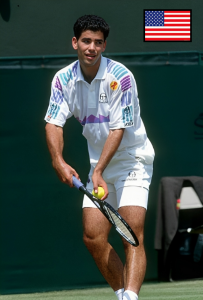 He began playing tennis at the age of three, hitting balls against a wall. On his 14th birthday, his father gave him two videotapes of Rod Laver and Ken Rosewall as a gift. “I watched these tapes several times a day. Their style of play, especially Laver’s, fascinated me. I wanted to play like him!” Influenced by Laver, Sampras switched from a two-handed to a one-handed backhand and adopted an attacking, net-rushing style.
His first notable success came in 1988, reaching the semi-finals in Schenectady. A year later, he reached the doubles final in Forest Hills with Jim Courier and won with him his first title in Rome – results that earned them a place in the 1989 Masters, remarkable & forgotten fact given that both would two years later become elite singles players. That same ’89 year he claimed his first big singles win, defeating defending champion Mats Wilander at the US Open in five sets, surviving nerves after a double fault on his first match point.
In February 1990, he won his maiden singles title in Philadelphia, defeating Andrés Gómez in the final. “I don’t know why there is so much hype around Agassi, Chang and Courier. Sampras is better than them!” Gómez said afterward. Six months later, Sampras stunned the tennis world at the US Open. Seeded 12th, he beat future No. 1 Thomas Muster, which was already a moderate surprise, then two great champions in succession – Ivan Lendl in the quarterfinal and John McEnroe in the semifinal – before defeating Andre Agassi in the final. At 19 years and 28 days, he became the youngest men’s champion in tournament history, a record that still stands.
That December he dominated the inaugural Grand Slam Cup in München, earning $2 million in one week – an unprecedented sum at the time. The year 1991 brought disappointments, including losses in the Cincinnati and Paris Mercedes Super 9 finals to Guy Forget, as well as a defeat to the Frenchman in the Davis Cup final, but the season was saved with Sampras’ first of his five “Masters” titles.
In 1992, Sampras claimed his first clay-court title in Kitzbühel, though clay would remain his weakest surface – he never won Roland Garros despite a few deep runs (1996 his only semifinal in Paris) and a title in Rome (1994). On April 12, 1993, he became the 11th player to reach No. 1 in the ATP rankings after winning Tokyo. That June he fulfilled expectations by winning Wimbledon for the first time. “In my mind this is the biggest one in the world, and now that I’ve done it I feel as happy as I’ve ever felt,” he said. He confirmed his dominance in tennis with the US Open title. He won 85 matches that year – the most since Lendl’s 107 in 1982 – and became the first player to serve over 1,000 aces in a season (1,011).
In 1994, Sampras won 10 of 12 finals and became the first player since Lendl (1987) to finish a second straight year at No. 1. That year he won his first Australian Open, being two points from defeat against 19-year-old Yevgeny Kafelnikov in the second round (5:4*, 30-all in the fifth). At Wimbledon he defended his title in impressive style. After two years of utter domination, Sampras’ third year on the top was threatened by two players: the arc rival Agassi and Muster, who was doing unbelievable things on clay. The Sampras-Agassi ’95 rivalry it’s a highlight of the 90s, they both were at peaks of their physical abilities co-creating four-set finals in Australia and America as far as majors are concerned, and three Mercedes Super 9 finals (Indian Wells, Key Biscayne and Montreal). Even though Agassi won that year more matches between them (3 out of 5) Sampras was more consistent and his third straight Wimbledon title gave him enough points to conclude third straight season as the ranking’s leader – it made an impact on Agassi, who realised that he lost the “who’s the best player of the 90s” rivalry, and decreased his motivation at the end of 1996.
May 1996 brought a personal blow: Sampras’ coach and friend Tim Gullikson died of brain cancer. Sampras joined the fight against cancer, pledging $100 per ace to charity. He also supported the Vitas Gerulaitis Youth Foundation and the Arthur Ashe AIDS foundation. On court, he finally lost at Wimbledon to one of his toughest opponents Richard Krajicek (in the quarterfinal), but triumphed at the US Open for the fourth time which helped him to achieve something McEnroe and Lendl couldn’t in the 80s, namely finish as the world best player the fourth straight season. He concluded it with an amazing five-set victory in Frankfurt against Boris Becker – that final I’d choose as the defining match of the 90s. Winning in 1997 his second Aussie Open and Wimbledon again for a fourth time, Sampras strengthened his position as the greatest grass/hard-court player of the Open Era, but he badly wanted to prove his versatility conquering Paris. From 1993 to 1997, many believed he could achieve a “Grand Slam” by adding Roland Garros to his collection – he reached the quarterfinals in Paris three straight years always losing the more natural clay-courters, and had proven in the Davis Cup ’95 final he would win the biggest title on clay, but Magnus Norman ended his hopes in the third round of 1997 when the tournament didn’t have a clear favorite. It was the last reasonable chance for Sampras to make his legacy grander.
By 1998, Sampras had matched Jimmy Connors’ record of five consecutive year-end No. 1 finishes, then broke it with a sixth. That year he also matched Björn Borg with five Wimbledon titles overcoming Goran Ivanišević in the final for the second time; in 1999, he broke the record with a sixth, and in 2000 he won Wimbledon for the seventh time, setting a new all-time Grand Slam record of 13 major titles, surpassing Roy Emerson’s 12 counting the pre-Open era. After defeating Patrick Rafter in the final, he tearfully looked up at his parents, who had not attended one of his matches since his junior days. People expected him to capture ten Wimbledon titles at least. Sampras admittedly was unable to finish a seventh consecutive season as the best player, but compensated it outplaying Agassi in the ‘Masters’ final.
The following years brought mixed results. In 2001, for the first time in 11 years, he failed to win a title, and his movement was visibly slower than in his prime, making his backhand a liability – especially on clay. At the US Open he was destroyed in successive finals (2000 and 2001) by “new balls” – players ten years his junior. Another player of that 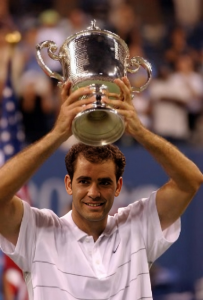 generation who spoiled Sampras’ dream of Wimbledon’s fifth title in a row it was Roger Federer, who struggled past Sampras in their only – legendary meeting – which in hindsight meant passing the torch. His Roland Garros record from 1998-2002 was just 3-5, with two five-set escapes against much inferior opponents.
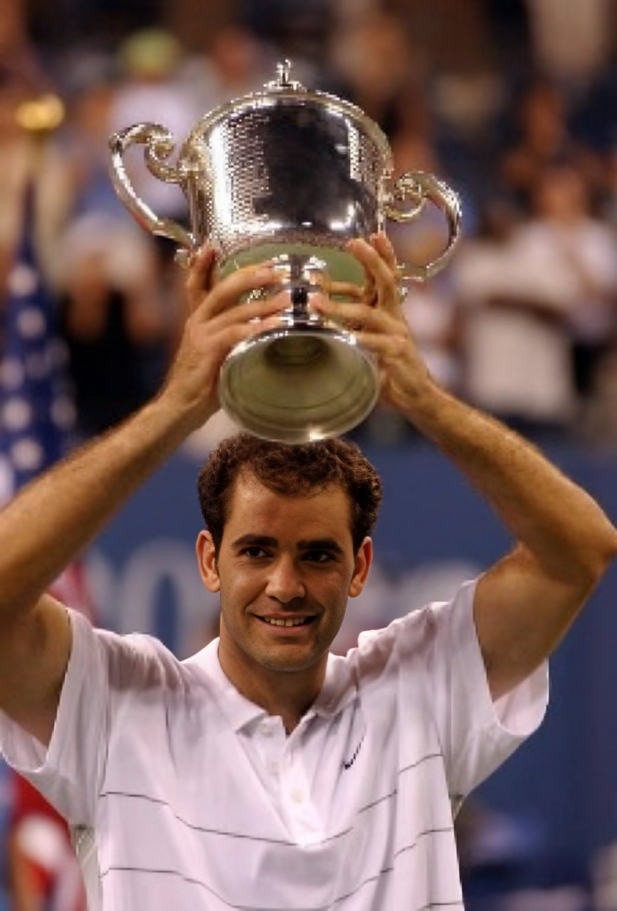
Then came his remarkable 2002 US Open run. Despite poor form entering the tournament, Sampras played inspired tennis, defeating Agassi in the final for a record-tying fifth US Open crown. “To beat a rival like Andre, in a storybook ending, it might be nice to stop,” he said. “But I still love to compete. I’ll see in a couple of months where my heart is and my mind. My head is spinning.”
Sampras never played another match. In August 2003, at a special ceremony before the US Open, he officially announced his retirement, ending his career with one of the most fitting finales in tennis history. At the time it seemed his record of major titles would never be beaten, strangely enough twenty years later as many as three players would win 20 Slam titles, but when Sampras finished his career the serve was much more dominant factor which – I’d argue – made winning the biggest titles more challenging, another thing it’s the fact that at the end of Sampras’ career the number of seeded players was extended from 16 to 32 which would allow the best players to avoid really tough opponents before the fourth round.
Sampras’ career can be viewed in three distinct phases (he played his whole career using a Wilson “St. Vincent” model):
– late 1980s blossoming: as a teenager he often resembled an American version of Stefan Edberg, the only great player whom Sampras never defeated in the 90s at “best of five” (three attempts, most important at the US Open ’92) – attacking the net behind each serve and even on the return with a cheap-and-charge mentality, usually not showing any emotions;
– the 1990s prime: he turned into the decade’s dominant force, building his game around two weapons, namely the serve and the forehand. He still came in after almost every first serve, but his volleys were deliberately simple rather than artistic-precise, first volleys designed to open the court, backed by the best overhead of his era (he introduced slam-dunk smashes) and superb movement that let him defend patiently with the backhand when required; especially in the second half of the decade he became more animated in his reactions;
– early 2000s twilight: as age and slower footwork set in and the hairline receded, his backhand turned into a clear target. Years of constant net rushing, however, left him with the most polished volleys of his career. Never a fan of long rallies even at his peak, he now avoided them altogether, taking greater risks on second serves and relying on relentless service holds to shorten points believing in his superiority while entering the tie-breaks (62% – one of the best ratios in history).
Career record: 762–222 [ 265 events ]
Career titles: 64
Highest ranking: No. 1
Best GS results:
Australian Open (champion 1994 & 97; runner-up 1995; semifinal 1993 & 00; quarterfinal 1998)
Roland Garros (semifinal 1996; quarterfinal 1992-94)
Wimbledon (champion 1993-95, 1997-00; semifinal 1992; quarterfinal 1996)
US Open (champion 1990, 1993, 1995-96, 2002; runner-up 1992, 2000-01; semifinal 1998; quarterfinal 1991)
Masters champion 1991, 94, 96-97 & 99
Davis Cup champion 1992 (played doubles in the final) & 1995
Grand Slam Cup champion 1990 & 97
World Team Cup 1993 champion
Year-end ranking 1988-2002: 97 – 81 – 5 – 6 – 3 – 1 – 1 – 1 – 1 – 1 – 1 – 3 – 3 – 10 – 13
This entry was posted in
Players. Bookmark the
permalink.



Activity: 1988 – 2002
Five-setters: 33–15 (68%)
Tie-breaks: 328–194 (62%)
Deciding 3rd set TB: 29-16 (64%)
Defeats by retirement: 7
Walkovers given: 8
Longest victory: Aussie Open ’90 (1R)… Tim Mayotte 7-6, 6-7, 4-6, 7-5, 12-10… 4 hours 59 minutes
Longest defeat: Munich-GSC ’93 (SF)… Petr Korda 6-3, 6-7, 6-3, 6-7, 11-13… 4 hours 32 minutes
MP matches: 16-9