1982 – 1983, US Open
U.S. Open, New York
August 30, 1982; 128 Draw (16 seeds) – $600,000; Surface – Hard
First US Open in nine years without Bjorn Borg. 3-time champion John McEnroe failed his title defense despite Borg’s absence because Ivan Lendl emerged as a real threat in the meantime. The Czechoslovak had beaten McEnroe five times within a year, and beat him for the sixth straight time in New York ’82. Lendl was constantly outplaying McEnroe, but couldn’t figure out how to beat Jimmy Connors. The American improved his H2H record vs. Lendl to 9-1 after a 4-set win in the final. Connors is the only player in history to win the same major event on three different surfaces (1974 – grass; 1976 – clay; 1978, 82 & 83 – hard).
Compilation based on the New York Times articles
First round:
Two seeded players, Vitas Gerulaitis and Jose-Luis Clerc, were eliminated in the United States Open tennis championships yesterday. Fritz Buehning, a 6-foot-5-inch pro from Short Hills, whose temper has often been as explosive as his serve-and-volley game, stunned the fifth-seeded Gerulaitis, 6-4, 7-6(4), 6-3. Last year Gerulaitis extended John McEnroe to five sets in the semifinals at the National Tennis Center in Flushing Meadows, Queens. ”My worst,” Gerulaitis said afterward, when asked if the opening-round match had been his most inglorious performance in a major championship. The pro from Kings Point declined to accept post-match questions on whether off-court pressures might have contributed to his defeat. It was the first time he had lost in the opening round of the world’s richest tournament since 1973. Name Mentioned at Gerulaitis’s 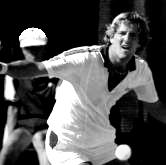 name was mentioned by Government witnesses in a Federal drug trial in Manhattan last week. The witnesses quoted the defendant as having said that Gerulaitis had been willing to participate in the purchase of cocaine. The player’s attorney has said he is not involved. ”I don’t think it hurt him physically, preparation-wise,’‘ said Buehning. ”Mentally, it might have had a little bit to do with it. When you walk on the court, I think you forget what’s going on around you. But a problem like that or a family problem, maybe it sticks in the back of your head, I don’t know.” The 22-year-old Buehning is ranked 56th in the world. Kim Warwick, the unseeded Australian who ousted the seventh-seeded Clerc in a fifth-set tiebreaker on the Grandstand court, is ranked 55th. Opening the tiebreaker with a stinging backhand cross-court return of a second serve, Warwick won it, 7 points to 3, and the match, 3-6, 6-4, 1-6, 6-1, 7-6. ”I had been going down the line on every point,” the 30-year-old Warwick said in discussing his tactics on the first point of the tiebreaker that led to a 4:0 lead. ”I had been waiting for a big moment to use that shot. It had been in the back of my mind for some time.” Also in the back of his mind was the realization that he had won only one singles match in seven tournaments since February, after undergoing surgery in his right shoulder in June, 1981. As late as last March, a doctor had advised him to give up the sport. Naturally gifted and underrated as a serve-and-volleyer, Warwick can be dangerous in the first round, particularly against a player like Clerc, who has yet to establish his credentials in major championships. It was the second time in five attempts that the 24-year-old Argentine had lost in the tournament’s opening round. He still tends to over-hit instead of relaxing, the result of tension and the inability to lift his game to the occasion. Gerulaitis has produced moments of greatness. He ousted Ivan Lendl here last year, handled him comfortably in the Canadian Open final last month and had been considered an outside threat to the McEnroe-Connors-Lendl domination here. Like Warwick, Buehning is a power player to be avoided in early rounds. Once the New Jerseyan had settled down after a 1-hour-25-minute rain delay at 3-all in the 1st set, Gerulaitis sensed he was in trouble. ”After the break, he came out and started playing a little bit better,” Gerulaitis said. ”Somebody must have told him to go for winners. I think he changed his strategy around a little bit.” The break allowed Buehning to talk in the locker room with Bob Brett, an Australian who is the coach of Team Peugeot-Rossignol, of which Buehning is a member. Before the break, Buehning became unsettled with several calls and had the center-service linesman moved to a sideline. ”He lost heart after the tiebreaker,” Buehning said. ”That broke his back. If it had been 1-all in sets, I think he might have outfitnessed me. I’ve been having problems with my feet.” If Gerulaitis had difficulty developing any rhythm, his problems were compounded by some spectators among the crowd of 14,146 who alluded loudly to the off-court publicity. Buehning said the remarks were clearly audible on the court. Buehning is conscious of his behavior. He is changing his act, he said, because ”fines have gone up. Now I don’t take it out on the linesman as much,” he added. ”I try to keep the volume down.” The chief benefactor of Gerulaitis’s departure could be Jimmy Connors, seeded No. 2, who could have faced Gerulaitis in the semifinals. Connors won his opening match, 7-6(5), 6-2, 6-3, from Jeff Borowiak. John McEnroe‘s 7-6(2), 6-4, 7-5 victory over Tim Gullikson was a completion of their match of Wednesday night that had been suspended by light problems and rain at 3-all in the 1st set. There was little in the match to suggest that the top-seeded McEnroe is on target for a fourth consecutive title. He was neither keen nor opportunistic. ”There were a couple of shots I should have been all over the ball to put it away,” he said afterward, obviously conscious of not hitting out on backhands and failing to serve out the match at 5:4 in the 3rd set. ”Instead, I just watched the ball float by. I have to get over that.” Ivan Lendl defeated Ramesh Krishnan 6-4, 7-6(6), 6-1 while current French Open champion, 18-year-old Mats Wilander (No. 11) outplayed Bill Scanlon 6-4, 6-3, 6-1.
Second round: Steve Goldstein
 Yannick Noah continued as the first-week force in the United States Open tennis championships. Noah’s impressive 6-3, 6-4, 6-4 victory over Brian Gottfried, after his opening-round, straight-set triumph over Kevin Curren, strengthened the lanky Frenchman’s credentials as a new top-10 member who finally may be ready to challenge for a major title. ”He played awfully well today,” said Gottfried, an established pro, who is unseeded here this year but has reached at least the third round of every Open since 1975, ”It was a set and a half before I got any returns in, and he played the big points well.” In contrast, Noah is carrying a quiet confidence, perhaps better prepared, mentally and physically, than he has ever been. Noah has broadened his game with an effective topspin backhand return. He won 11 of his 15 service games at either love or 15. ”I’m more confident because I had to play well in the first match,” he said. The third day at the National Tennis Center produced several mild surprises with the second-round defeats of two seeded men, Mark Edmondson of Australia (No. 13) and Raul Ramirez of Mexico (No. 15). Matt Doyle, a member of Ireland’s Davis Cup team, handled a snarling Edmondson in four sets, after the burly Australian squandered a chance for a two-sets-to-love lead at 6:2 in the 2nd set tiebreaker. The scores were 1-6, 7-6(6), 7-5, 6-2. Schalk van der Merwe of South Africa overpowered Ramirez with 15 aces in a 6-2, 6-3, 5-7, 6-4 decision. A match halted one day earlier by rain and lightning ended yesterday in thunder as Tim Mayotte came within a hair of knocking pre-tournament favorite Ivan Lendl out of the U.S. Open. The thrilling match had real Davis Cup flavor as the partisan crowd went berserk when lanky, mop-haired Mayotte took a lead of two sets to one over the third-seeded Czech. His best chance came and went with a 4th-set tie-breaker, however, and though Mayotte, 22, saved five match points in the 5th set, he had to be content with the thunderous ovation accorded him from the packed grandstand. Lendl won by scores of 6-4, 3-6, 4-6, 7-6(4), 6-4 in 3 hours 13 minutes. Mayotte ‘s gallant effort capped a superb day of tennis that saw a U.S. Open record throng of 20,738 pass through the gates of the National Tennis Center. It also overshadowed an amazing contest between another rising young star, Chip Hooper, and a faded one, Roscoe Tanner. Unseeded Hooper scored a mild upset when he toppled 16th-seeded Tanner after 4 hours and 24 minutes, 6-7(2), 7-6(5), 4-6, 7-5, 7-6(4). The Lendl-Mayotte match featured the best tennis and the most excitement, though its origin 24 hours earlier had hardly hinted at that. Lendl was serving at 6-4, 1:2, 30/15 Thursday evening when lightning lit the sky and rain flooded the court. Both players were unhappy with the way they were playing – Lendl termed his performance “worse than lousy” – so they welcomed the delay. Mayotte gained confidence overnight because he saw how poorly Lendl was playing. “I had a feeling last night that he wasn’t
  playing as well as he was during his winning streak,” said Mayotte, who immediately went out and won the second and third sets by holding his own serve and breaking Lendl’s once in each set. Mayotte’s potent serve – he had 19 aces – was the difference, Lendl said later. Mayotte made the most of Lendl’s errors. The 4th set saw Mayotte struggle a bit, but he straggled into the tie-breaker to a standing ovation. Mayotte was three points away from the upset of the year, at 4:4, but Lendl won those three points on two errors by Mayotte and a brilliant service return. “I didn’t get down after that. I was in it the whole time,” Mayotte said. ”I was ready for the fifth set.” And so he was. He held serve and broke Lendl for a 2:0 lead. But then Lendl fashioned a break of Mayotte’s serve for the first time in 24 hours, and it was even. After both had held serve, Lendl broke again in the 7th game for the edge he needed. Serving for the match at 5:4, Lendl went up, 40/0, and then quickly squandered all three match points, the final one on a double fault. Did Mayotte have a miracle left? He had two more mini-miracles left, saving Lendl’s fourth and fifth match points, but a forehand went long on the sixth, and that was it. Mayotte, who termed the crowd’s reaction “one of the highlights of my career,” was disappointed that he “missed an opportunity to boost my confidence” in beating favored Lendl. Mayotte said part of his success was due to thinking of Lendl as just another opponent. Hooper, who had a disappointing Wimbledon (he lost in the second round) and an even more disappointing summer, definitely had upset on his mind. Lawrence Barnett Hooper III, son of a surgeon from Sunnyvale, and who answers to Chip or Hoops, has the distinction of being able to unload very hard serves from the peak of his 6-foot, 6-inch frame. Tanner at 30 has slowed down some, but his low toss and rapid-fire delivery make it difficult to pick up the ball. In the end, it was Tanner who had 24 aces to Hooper’s 9, and two of Tanner’s gave him the final two points in the first-set tie-breaker. Hooper wasted several opportunities to break Tanner’s serve in the 2nd set and then took a 5:1 lead in the tie-breaker, only to let it slip back to 5:5. But Tanner double-faulted, and Hooper followed with a winning volley to even the match. In the 3rd set, Tanner was down a break and serving at 2:4 he served four straight aces to take the game and was so pumped up, he won the next three and the set. The players changed rackets almost as often as sweat-drenched shirts, as the hard hitting repeatedly broke racket strings. Tanner had the match almost sewn up in the 4th set. He was serving at 4:2, hit a bad patch of errors and saw Hooper catch fire and once again even the match. It seemed inevitable that the match would come down to 5th-set tiebreaker, but the drama was heightened by a play earlier in the set that saw
  Hooper nail helpless Tanner with a forehand rocket. Tanner thought Hooper did it intentionally and muttered an oath in his opponent’s direction. Hooper denied it had been on purpose. The decisive tie-breaker saw Hooper win the first three points. Tanner struggled back to 3:5, but he netted a low volley to give Hooper two match points. The Californian wasted one with a long volley, but Tanner followed with a long volley off a Hooper backhand. Hooper threw down his racket and raised his fists in triumph. “I didn’t like his tactics,” Tanner said. “I should have put him away in the fourth set and I’m sorry I didn’t.” John McEnroe, seeking to salvage a disappointing year by winning the Open for the fourth consecutive time, took a 7-6(2), 6-4, 6-3 victory over Marty Davis. McEnroe was troubled by a swirling wind and Davis was serving for the first set at 5:4. McEnroe broke, then won the tiebreaker, and had little problem the last two sets. Jimmy Connors, seeded second, defeated Hank Pfister, 6-4, 6-3, 6-2. Guillermo Vilas, seeded No. 4, beat Marcos Hocevar, 6-4, 6-2, 6-3, Mats Wilander outplayed Bruce Manson 6-2, 7-6, 6-1. Qualifier, 20-year-old Scott Davis survived against (No. 14) Brian Teacher 7-6(4), 7-6(3), 7-6(5) – first US Open straight setter consisted of three tie-breaks.
Third round:
For the purists, John McEnroe‘s straight-set victory over Vince Van Patten in the third round was especially noteworthy (6-3, 6-2, 6-3). ”It’s the best I’ve felt in the three matches,” the top-seeded defending champion said. ”I think he played very, very well,” Van Patten said. ”He returned very well, I couldn’t get him from either side. He was getting a lot of balls back and he served well. He should be happy.” For the upset-minded, the defeats of Chip Hooper and Fritz Buehning merited more than routine consideration. And then there was Ilie Nastase‘s five-set victory over 10th-seeded Johan Kriek of South Africa. It was a 3-hour-30-minute roller-coaster match. At the age of 36, with many of his best shots behind him, the irrepressible Nastase skillfully soft-balled an impatient Kriek out of any rhythm and captured the hearts and cheers of a capacity afternoon crowd of 20,787. In the past, the crowds here had jeered at his behavior. Some of his peers and friends showered him with paper confetti when he returned to the player lounge after his 4-6, 7-6(2), 6-7(8), 6-3, 6-2 victory. For all his many fines and run-ins with officials, he has been popular with rivals over the years, and it has been a long time between such satisfying moments for the 1972 champion. Nastase will face his longtime friend, Jimmy Connors, seeded No.2, in the fourth round. Locked at one-set-all with Jimmy Arias in the feature evening match, Connors came from 1:4 in the 3rd set, sweeping nine games and winning, 6-4, 4-6, 6-4, 6-1. It was his first meeting with the 18-year-old Arias, whose performance was impressive, even in defeat. Hooper’s 6-7(4), 6-4, 7-6(6), 6-3 loss to Tom Gullikson, and Buehning’s 7-6, 3-6, 6-2, 6-2 setback by Jaime Fillol again demonstrated that Grand Slam championships require more than one joyous day in the sun. But the match that typified the day was Nastase-Kriek. There were patches of solid shot-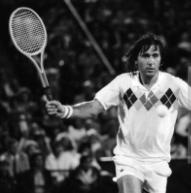 making, 21 double faults by Kriek, dramatic elements such as Nastase’s squandering a 5:0 second-set lead and then winning a tiebreaker, and even comic relief. The longer the match lasted, even after Kriek had taken the third set tiebreaker, 10/8, the worse it became for him. Nastase maintained his calmness, and enjoyed the unaccustomed spectator support, particularly repeated cries of ”Come on Nastase!” by one shirtless fan at inopportune moments. ”Can’t you get him out of here?” Kriek asked Jay Snyder, the umpire, at a moment in the 3rd set. The fan continued his cheers for Nastase, and Kriek approached Snyder later and said, ”Either you get him out of here, or I get him out of here.” Nastase paused before serving, and shouted at Kriek: ”For 15 years, they’re all against me! ‘You only got him!” On the court where he created an ugly scene in a losing match against McEnroe three years ago, Nastase held himself together, even after Kriek had broken for a 2:0 lead in the 5th set. He peppered a side linesman with words for calling Kriek’s serve an ace at match point, but never lost control of the situation. By contrast, Kriek sprayed ground strokes, volleys and smashes every which way, as if he had underestimated Nastase, could not contain his impatience and wanted to end matters quickly. ”For me to go to the last 16, it’s great,” Nastase said. Asked when he had achieved such a satisfying victory, Nastase, who is only 97th in the world now, thought for a moment and said, ”A long time ago.” Hooper won a five-set serve-and-volley shootout from Roscoe Tanner in the second round last Friday that went to a decisive tiebreaker. Gullikson wisely shunned such tactics and chipped returns, forcing the 6-foot-6-inch Hooper to bend for first volleys. But the key to Gullikson’s victory may have been a more positive attitude he said he has taken in recent months since he met a Denver sports psychologist, Jim Loehr. Gullikson said Loehr not only gave him tapes to listen to, breathing exercises and workout sheets to absorb before matches, but also changed specific rituals on the court. ‘‘He changed the way I walk on the court,” Gullikson said. ”We were practicing one day, and he said I walked too slow on the court and that I suffered from a low-energy level. I used to lose a lot when I was ahead. My attitude was negative, and I’d be thinking, ‘All I have to do is hold serve one or two more times.’ Now, I try to play each point. What it does it keep you in the present more. What happens in the past and future doesn’t count.” Hooper won the first-set tiebreaker, served for 5:3 in the 3rd set and held two set points with Gullikson serving at 4:5. But Gullikson, whose computer ranking is 80 (Hooper is 27), took the third set, won the fourth and advanced to a fourth-round date against Fillol. Mats Wilander notched straight sets victory for the third time in a row defeating Tim Wilkison 6-4, 6-1, 7-6 and Ivan Lendl second time in career destroyed Harold Solomon in New York, 6-3, 6-0, 6-1 (two years earlier dropped just one game). Solomon had won their first encounter 6-1, 6-1, then lost all 16 sets they played never obtaining more than 4 games in a set! For Eric Korita, 19, the nervousness began Friday night, when he found out that his third-round match with Yannick Noah in the U.S. Open was set for the cavernous stadium at the National Tennis Center. “I was shaking for about an hour,” Korita recalled. “I’d never experienced anything like this before.” The nervousness ended for the qualifier when he won his first service game yesterday. Shortly thereafter, it was Noah, the ninth seed, who was shaking in his tennis shoes. For 3 hours, 32 minutes, Korita, ranked 335th in the world, made big trouble for one of the game’s luminaries. Noah finally won, 7-5, 6-7(3), 6-4, 3-6, 6-4, but it was more a victory for experience than quality of play. Korita actually held a break point at 4:4 in the final set. His service return went long, however, and Noah held for 5-4, then capitalized on errors to win the next game on his third match point. “I was that close,” Korita said, holding his thumb and forefinger an inch apart.
Fourth round:
” Wasn’t that fun?” a smiling Jimmy Connors asked after his sideshow with Ilie Nastase concluded last night. Depends upon your point of view, Jim. The carnival antics of Nastase and, to a lesser extent, Connors clearly were what the crowd wanted. But, if you think Nastase’s attempts to humiliate the officials is fun, then it was a bad show. Connors mercifully put the 36-year-old Nastase out of his misery in straight sets, 6-3, 6-3, 6-4. The fourth round match between the long-time friends had its moments of quality tennis, but its shabby beginning cast the evening’s main event in a circus atmosphere. As one observer said, it appeared Connors and Nastase had rehearsed their opening act like pro wrestlers. Their first objective: destroy umpire Don Wiley. By the time three games had been played, Nastase had received a code warning and point penalty and Connors had seen a code violation assessed, then retracted. In the time it takes most tennis players just to work up a good hate, Nastase had scored the hat trick: he was crude, rude and lewd. As the players changed sides with Connors leading, 3:0, Nastase hollered at someone, presumably a fan, to “get 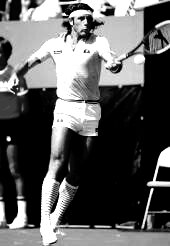 the bleep out.” Then, as he sat down, he yelled, “Bleep you,” at Wiley and threw a towel at the Villanova alumnus, who was prominently seated, high in the umpire’s chair. Midway in the match Nastase stopped at Wiley’s chair, poked his racket at Wiley’s leg and said, “Look at me one more time and I’ll kill you.” Long forgotten by the Jimmy Connors-Ilie Nastase show was Guillermo Vilas‘ mid-day comeback against Steve Denton. The tall Texan, seeded No. 12, took the first two sets, 6-3, 6-4, then the fourth-seeded Vilas won, 6-3, 7-6(4), 6-3. “I think my experience helped,” Vilas said. ”I’ve been in trouble before and know what it takes to come back.” Still, everyone, including Vilas’s coach, Ion Tiriac, was raving about Denton’s serve, which produced 25 aces, to 5 by Vilas. “I’ve never seen anyone serve like that for 3 1/2 hours,” Tiriac said. Denton’s first serve crashed in an astounding 72 percent of the time. Vilas’ first-serve percentage was higher – 78 percent – but he served with considerably lower speed throughout. Still, he had an ace when it counted, on match point. With Vilas facing unseeded Tom Gullikson in the quarter- finals, who outplayed other 36-year-old player – Jaime Fillol 6-4, 6-3, 6-3. It’s almost like the old joke. One fellow says to another: “I went to my doctor the other day, and he told me my shoulder was so bad I had to give up tennis.” Second fellow: “So what did you do?” First fellow: “I got another doctor.” Kim Warwick was told exactly that five months ago – your shoulder’s in rotten shape, give up the game, you’re finished. Yesterday, continuing to defy the odds, Warwick extended his remarkable run at the U.S. Open, ousting ninth-seeded Yannick Noah, 5-7, 6-3, 7-5, 6-4, before a roaring grandstand crowd. Warwick, 30, had won only three matches in six visits to the U.S. Open before this year. Now the sandy-haired Australian with the jutting jaw has advanced to the quarterfinals, beating seventh-seeded Jose-Luis Clerc in the first round and losing a total of only eight games in his second- and third-round matches. Warwick, ranked 55th in the world, is the hottest player in the Open going into a quarterfinal meeting with Ivan Lendl, who looked impressive – no, make that awesome – in avenging his French Open defeat to the two-fisted backhand of Mats Wilander. Lendl ripped through the Swedish teenager, 6-2, 6-2, 6-2, in less than 2 hours. Wilander found that the back-court game he used to win the French Open was useless against the relentless Czech. “I’m a little bit disappointed, but he played very well,” Wilander said. ”I can play a little bit better, but if he’s playing like this, I can’t beat him.” Asked if he had gotten particular satisfaction out of beating the Swede, Lendl said, “Definitely. I got a lot of garbage after the French Open for losing to someone no one ever heard of. Fortunately, he won the tournament.” The Czech said the difference was in the harder, faster DecoTurf II at Flushing Meadow. “The court here is a lot faster. His defense cannot be as good.” As for his own play, Lendl said, “I’m hitting the ball pretty hard, pretty deep – that’s all I need.” Lendl, who normally minces words when asked about his own performance, was unusually confident last night. Was he pleased with his game? “Very,” he said, stating what was obvious to everyone. Joining Warwick and Lendl in the final eight
 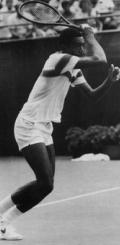 yesterday was John McEnroe, who toyed with Matt Doyle, 6-3, 6-4, 6-4. The defending champion and top seed’s quarterfinal opponent will be Gene Mayer, the sixth seed, who won over Bob Lutz, 6-4, 6-2, 6-1. Mayer has been playing well and thus far has avoided the injury jinx that has forced the native New Yorker to retire from 16 matches with injuries during his career. Rodney Harmon of Dennis Ralston’s stellar performers on the Southern Methodist University tennis team, surprised eighth-seeded Eliot Teltscher by winning a fifth-set tie-breaker, and the match 6-4, 4-6, 6-3, 3-6, 7-6(1). Harmon served for the match at 5:4 in the final set and actually had a match point, but he lost with a double-fault. That terrible twist of fate did not discourage him, however, because he had been going for a winner with his second serve. “I didn’t feel like I choked,” said Harmon. “I still felt I could beat him in the tie-breaker.” Harmon had a bout of food poisoning on the eve of the Open and said he was lucky to win his first-round match against Rolf Gehring. For the 21-year-old Harmon it was a Grand Slam debut, he never again played a good major and retired prematurely in 1985
Quarterfinals:
John McEnroe recovered from opening-set loss Wednesday to reach the semifinals of this year’s competition. McEnroe, in quest of a fourth consecutive Open crown, dropped the first set and was down a break in the second before recovering for a 4-6, 7-6(4), 6-3, 4-6, 6-1 victory over sixth seed Gene Mayer in a match lasting 3 hours, 36 minutes, and Ivan Lendl required only 1 hour and 36 minutes to topple Australian Kim Warwick, 6-4, 6-3, 6-1, and stretch his match record for the 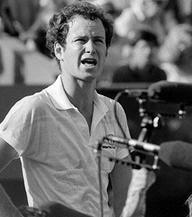 year to 86-7. In Saturday’s men’s semifinals, McEnroe will meet Lendl. “I expected a tough match and I think it was a tough match,” McEnroe said. “I was glad that I concentrated well in the fifth set. I started slowly then I let it slip away later. I thought I was in control from the third set on, but I just couldn’t put him away.” Mayer, who has won only one of nine career meetings with McEnroe, broke service to open the match and then broke again in the 9th game when McEnroe was long with a forehand smash. Mayer again broke service to open the 2nd set, but McEnroe retaliated with consecutive breaks in the 2nd and 4th games and then won the eventual tiebreaker, rallying from a 1:3 deficit. McEnroe got upset in the opening set when several foot faults were called against him. Following a discussion, umpire Charles Beck agreed to rotate the linespeople. Lendl never dropped his service and broke Warwick in the fifth game of the opening set, the first game of the second and twice in the third, when he raced to a 5:0 lead. Jimmy Connors, that doddering old man of 30, yesterday reached the semifinals of the U.S. Open for the ninth time. His semifinal opponent tomorrow will be fourth-seeded Guillermo Vilas, who last night raced through Tom Gullikson, the left-hander of the tennis-playing twins, 6-2, 6-1, 6-3. The Connors-Vilas & McEnroe-Lendl semifinal pairings give the tournament a historic flavor, as well as offering glamour and exciting contrasts in styles. Not since 1969 had the top four men’s seeds in the Open reached the semifinals. The top four have not reached the Wimbledon semis since the era of open tennis began in 1968. Vilas, who turned 30 a month before Connors, is making his best U.S. Open showing since winning the tournament at Forest Hills on clay – his favorite surface – by beating Connors in the 1977 final. He has beaten Connors twice this year on clay, but the Open is now played on hard courts at the National Tennis Center in Flushing Meadow. Characteristically, Connors was unimpressed yesterday by the fact that he had made the semifinals here again. “It’s no big feat for me just to uphold my seeding,” said Connors , who is seeded second. “I’d like the ninth
 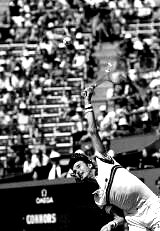 year not to be just a semifinal. I played well to get there, so let’s go on and win the tournament. I’m used to winning.” Connors’ last obstacle to a berth in the semis turned out to be a 93-minute quarterfinal against Rodney Harmon, an amateur from Richmond, who had gotten advice on how to play Connors from Arthur Ashe, who beat Connors in the 1975 Wimbledon final, and former pro Dennis Ralston, Harmon’s coach at Southern Methodist. But nothing could stop the Connors steamroller, which produced a 6-1, 6-3, 6-4 rout. In fact, the advice may have hurt. “The whole time I was out there, I was trying to play a style that wasn’t conducive to the way I play,” said Harmon, 21. “I just should have played the game I play well, which is to play aggressively.” Harmon is a big hitter, but he toned his game down, trying to slice the ball. It didn’t work. But Ashe, who beat Connors at Wimbledon with off-pace shots, defended the advice.
Semifinals:
Ivan Lendl ended John McEnroe‘s three-year dominance in the United States Open tennis championships yesterday. Lendl’s victory by 6-4, 6-4, 7-6(6) extended his string of Grand Prix triumphs over McEnroe to six in the last 18 months. During that span, McEnroe has won only one of their 17 sets. Jimmy Connors opened the semifinals with a 6-1, 3-6, 6-2, 6-3 decision over Guillermo Vilas. Not even courtside hand signals from his coach, Ion Tiriac, could help the Argentine crack Connors, seeded second, who holds an 8-1 career edge over the third seeded Lendl, but many of his victories were achieved before the lanky Czechoslovak became an established force on the circuit. In their most recent meeting last month, on a hard surface in the semifinals of the Association of Tennis Professionals championships, Lendl was hot and Connors was not, and the result was a 6-1, 6-1 rout. In reaching his second Grand Slam final (he lost to Bjorn Borg in the 1981 French Open), Lendl powered through a demanding draw. Before McEnroe, his victims were Ramesh Krishnan, Tim Mayotte in five sets, Harold Solomon, Mats 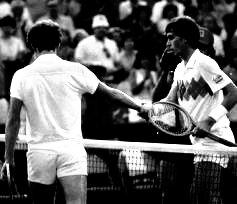 Wilander and Kim Warwick. The final will start at 4 P.M. today, the last day of the $1.5 million championships. The program yesterday drew another capacity crowd of 20,797 to the National Tennis Center in Flushing Meadows, Queens. The demand for tickets was so strong that scalpers were getting $125 a ticket. McEnroe was frustrated throughout the 2-hour-39-minute match. Just as McEnroe emerged with a serve-and-volley game to dominate Borg, after Borg’s topspin style had controlled Connors, Lendl has developed the strokes and power that McEnroe said ”get me disorganized.” McEnroe did not help himself by moping between points, repeatedly questioning close calls, banging his racquet on the ground, then confronting a mobile cameraman at 6-all in the 3rd-set tiebreaker. Leading by 5:2 in the tiebreaker, he had two serves for the set. But Lendl won a close volleying exchange at the net, then McEnroe double-faulted long. He saved one match point at 5:6 with a forehand volley winner. After tugging at the cord attached to the camera on the 6-all changeover, when the cameraman changed positions and wandered onto the court, McEnroe raised his left arm to the cheering crowd before serving. But the celebration was brief and insignificant. Lendl hammered a forehand cross-court return of a second serve and another punishing cross-court forehand that McEnroe returned wide on the backhand. ”He forces me to do things differently,” McEnroe said of Lendl’s improving serves and returns. ”That’s the mark of a great player.” McEnroe did not serve well, managing only 49 % of first serves. Forced to attack off his second serve, he ran into paced, angled returns that nullified any force or depth in his first volley. There were only two service breaks in the match. McEnroe volleyed away the 5th game of the 1st set, and Lendl opened the 2nd set with a break. Lendl faced 0/30 while serving at 5:4 in the second set, and break points in the 2nd and 4th games of the 3rd set, but never lost serve. ”He’s improved his serve,” McEnroe said. ”It’s harder for me to attack it than it was before.’‘ His inability to handle the serve involved more than power or stroke production. Unlike Connors, who uses his returns as an offensive weapon, McEnroe prefers to block, push or guide his returns, and play his way into the point. But many of the returns landed short, around the center-service line, and allowed Lendl to move in for deep forehand cross-court approach shots that left McEnroe little or no room to pass. ”The difference between now and when I would lose badly to him is the return of serve from both ways,” said Lendl, who raised his record for the year to 86 victories in 93 matches. This is his 19th tournament; he has won 11 and finished as runner-up in five. Connors seems to win Open titles in even-numbered years. He won in 1974, 1976 and 1978. As always, Connors gave the crowd an invigorating show. A victory over Lendl, coupled with his five-set triumph over McEnroe in the Wimbledon final earlier this year, would almost certainly give him the No.1 ranking. There was another satisfaction for Connors. Throughout the match, he was aware that the fourth-seeded Vilas was receiving courtside hand signals from Ion Tiriac, his mentor. Many of Vilas’s tactics appeared to follow directives from Tiriac, a former Romanian Davis Cup player. ‘‘You can coach with your hands, but not verbally,” Mike Blanchard, the referee, said. Tiriac’s signals varied from a flick of an index finger to rubbing a knee. But because Vilas sometimes stood so close to him, Tiriac could be seen mouthing words to the Argentine left-hander. Watching Tiriac watch Vilas was a sideshow, and Connors left no doubt about his displeasure. ‘‘That’s a bunch of bull,” he said afterward. ”As long as he’s only giving signals, you can’t do anything. If he starts talking, that’s something else. But he’s a big-enough boy now. He should be able to do it by himself.” Vilas had won their only two meetings earlier this year, both indoors, and had been among the few players with a career edge (5-4) on Connors. The match did not take shape until the 2nd set, after Connors had broken serve at 30 in the 4th and 6th games of the opening set. Vilas found a working formula by mixing topspin forehands across court and sliced backhands down the line; as a result, Connors could never get a groove on his forehand. Serving at 1:2, 40/15 in the 2nd set, Connors suddenly struck a bad patch. Vilas
  drove a backhand winner down the line at deuce and broke for the first time on another Connors forehand into the net. The 3rd set became a drama within a drama, with Connors trying to solve the forehand riddle, Vilas glancing at Tiriac and Tiriac sending hand signals. But despite Tiriac’s efforts, Connors took control. Instead of going for a winning shot on the second or third hit in a rally, Connors patiently played for angle and position, waited for the short ball and then attacked. The points came for him in bunches and by the eighth game, Connors was in full throttle, sweeping 16 of the last 18 points in the set. The 4th set found Vilas repeatedly in trouble. He held from 15/40 in the 2nd and 6th games, then Connors attacked, broke at 30 for 5:3 and served out the match. ”He played very risky,” Vilas said. ”So many lines and very difficult angles. He went for them. If they were not going his way, then I was going to win in four sets easy. But the way he was hitting the ball, he was hitting the ball, he was hitting winners even from the baseline. Not many players can do that.”
Final:
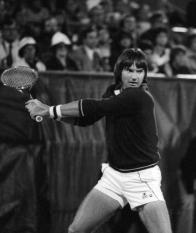
In a way, Jimmy Connors said, his fourth U.S Open title – the one he won yesterday – was the most satisfying. “When I won before, everyone thought that I would,” Connors said. “When I won now, everyone thought that I wouldn’t.” The man at least some people thought might win this tournament for the fourth straight year, John McEnroe, was several hundred yards away at Shea Stadium, watching the Jets-Dolphins game. The man most people thought would win, Ivan Lendl, played poorly for the first two sets of the final, making an unusual number of errors. By the time Lendl found his strokes, midway through the third set, Connors was pumped so full of desire that he 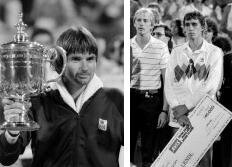 literally willed a victory. When that victory came, the scores were 6-3, 6-2, 4-6, 6-4. Where Lendl had beaten McEnroe in the semifinals while hammering McEnroe’s serve back for winners, he could do little with Connors’ well-placed delivery. Connors battered Lendl with deadly shots that kept Lendl pinned to the baseline, and Lendl’s only effective passing shots came late in the match – too late. More often than not, he was wild or his shots were deftly put away by an acrobatic Connors. Connors’ legs were so tight from all his racing around that he was forced to stand during his post-match interview to avoid cramping. Despite that, he had ascended to the No. 1 ranking in world tennis, delighting a frenzied crowd of 20,532 at Louis Armstrong Stadium. Asked if it had been difficult to play Connors here, the Czechoslovakian said quietly, “It is difficult to play him anywhere.” In winning Wimbledon and the Open this year, Connors duplicated a feat that he had achieved in 1974, the first year he was ranked No. 1. Yesterday’s winner’s check of $90,000 vaulted Connors over the $4 million mark in career tournament prize money, making him the first male player to reach that milestone. As Chris Evert Lloyd did Saturday, after winning her sixth Open singles title, Connors hinted that he might retire from tennis. Asked how it felt to be back on top, he said, “You may not see me anymore.” Connors said that he would take off most of November and December and then ”sit down and think it out.” “I did what I wanted to do,” he said. “I got back to where I wanted to be as far as winning Wimbledon, and that was my goal. To come here and continue to work hard after Wimbledon and win the tournament at 30 years old is pretty good.” Connors seemed loose when yesterday’s match began. Lendl appeared nervous and uncomfortable. Lendl became even more nervous after dropping the first two sets in a total of 80 minutes: Connors served well over that span, putting 67 % of his first serves in, while Lendl struggled at about 43 %. The Czechoslovakian never took the offensive. He was beaten by Connors’ driving approach shots, and he missed badly with his attempts to pass the American. “I was slow,” Lendl said. “I was coming late for the ball. My footwork wasn’t good.” Lendl looked like a loser, never more so than when Connors broke his serve in the 3rd game of the 3rd set for a 2:1 lead. Lendl could only shrug his shoulders and look to his coach and friend, Wojtek Fibak, sitting at courtside. In desperation, Lendl started hitting out more, and Connors , who looked as if he were tiring, started missing. Lendl broke Connors’ serve in the 6th game for 3:3, then saved two break points against his own serve to lead by 5:4. With Connors serving, Lendl reached set point on a Connors error, but he lost the point on a brilliant backhand winner by Connors. Another Connors error created a second set point, and Connors followed by netting a backhand approach. Now Lendl needed two more sets. The key point in the match came in the 5th game of the 4th set. Lendl had just broken Connors’ serve to even the set at 2:2, but Connors came roaring back in the next game. After Lendl had served an ace for 30/30, Connors followed with a lunging forehand volley winner and a backhand volley winner to secure the break. Then Connors held for 4:2. “I just made up my mind then that I was coming in on everything,” Connors said. “If he was good enough to pass me 20 times, then he was going to win the match.” Lendl wasn’t good enough. He held his own serve
 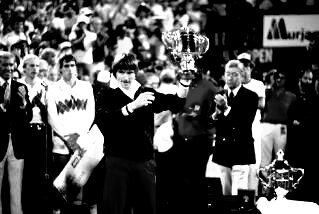 for 3:4, but Connors held at love for 5:3. The crowd cheered wildly as Connors raised a finger in the air and shouted, “One more, one more.” Lendl held again, but only after Connors had further stoked his emotional fire with a running forehand winner on the first point of the game. At 5:4, they changed sides, the crowd bellowing in anticipation. Connors lost the first point with an error but got to 15-all by putting away a volley after a long rally. He made it 30/15 with a serve-and-volley combination. Now Connors held up two fingers, indicating the number of points needed for victory. He got one of the points when Lendl mis-hit a backhand wide. On match point, the Czechoslovakian despondently netted a backhand, and that was it. Connors shook his upraised fists in jubilation. Who knows if Connors could have mustered enough energy for a fifth set? “I had a feeling he was getting tired,” Lendl said. “My only chance was to keep him out there as long as I could.” “I didn’t want to go five sets, that’s for sure,” Connors said. Then Connors talked about what a good time this would be to quit tennis. “I still have a couple of good years left in me,” he said, “but I don’t want to go flying around all over the place, like I do now.” For Lendl, 22, who has won 10 of the 18 tournaments he has played this year, a major championship remains an elusive goal. “I just did all I could,” he said, refusing to open the wound any further. “It’s not the end of my career. It’s not the end of my life.” Connors’ 96th title (7th major). Stats of the final
**************************************
U.S. Open, New York
August 29, 1983; 128 Draw; $797,000; Surface – Hard
The eighth and last major title for Jimmy Connors, who beat Ivan Lendl second straight year in a 4-set final. It was a tournament which made a “Bollettieri” name famous. Two young pupils of his tennis academy (he’d opened it five years before) made a fuss: 16-year-old Aaron Krickstein, and three years older Jimmy Arias who advanced to the semi-finals and looked like a future major champion, but it was a highlight of his career; the American never again played in the last 4 of a Grand Slam event (he didn’t even win a tournament after 1983!). Krickstein had prevailed two dramatic 5-setters and winning a fifth set maintained a hallmark to the end of his career.
First round: Steve Goldstein
Yesterday, the Grim Racket swatted away No. 8 seed Jose Luis Clerc. And, for a few anxious hours following Tom Wilkison‘s 6-2, 6-3, 7-6(4) conquest of Clerc, top-seeded John McEnroe and No. 15 Vitas Gerulaitis looked to be in trouble. Unheralded Trey Waltke, who created a stir by wearing long trousers at Wimbledon this year, yesterday scared the pants off top-seeded John McEnroe in a first-round match at the U.S. Open Tennis Championships. McEnroe rallied from a deficit of two sets to one to win, 6-3, 5-7, 4-6, 6-0, 6-1, at the National Tennis Center in Flushing Meadow, but the cost of his victory was dear. McEnroe was cruising, leading by 6-3, 4:1, when he seemingly lost his concentration, stopped moving and committed a rash of unforced errors. “Movement is a big part of my game, and if I’m sluggish, everything kind of falls apart,” he said later. A verbal altercation with two court-side fans and words with the chair umpire resulted in fines totaling $1,850. Levied by the Grand Prix supervisor’s office, the fines brought McEnroe ‘s total for the last 12 months to $7,300, only $200 less than the amount that results in a player’s 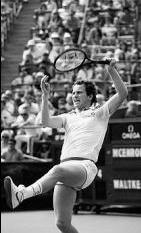 being automatically suspended for 21 days, pending appeal. If McEnroe were to go over the limit here, it would not affect his Open participation, but it would jeopardize his eligibility for the United States- Ireland Davis Cup match Sept. 30 through Oct. 2. The tempestuous three-time winner of this event was fined $1,000 for abusing the two spectators after uttering obscenities and throwing sawdust at one. He also was docked $500 for verbal abuse of umpire Stu Saphire and $350 for whacking a ball into the stands, narrowly missing comedian Alan King’s trademark plantation hat. Apart from McEnroe ‘s narrow escape against Waltke, the first day of the $2 million tournament produced mainly predictable results. Even the ouster of eighth-seeded Jose-Luis Clerc of Argentina by Tim Wilkison of Asheville, who is ranked 73d in the world, was not startling, given Clerc’s poor record on cement. Wilkison’s straight-set victory added to Clerc’s mounting woes in major championships. The Argentine lost in the second round of this year’s French Open and in the first round at Wimbledon. In an evening match, third-seeded Jimmy Connors defeated Ramesh Krishnan, 6-2, 6-4, 3-6, 6-2. Vitas Gerulaitis, a former finalist and the tournament’s 15th seed, saved three match points in the 4th set before beating Brazil’s Marcos Hocevar 3-6, 3-6, 6-2, 7-5, 6-4. “If I can just get past the first couple of rounds, I can do some damage in this tournament,” Gerulaitis said. Hocevar led 5:1 in the 4th set! OK, many internationally renowned players are sentenced to the outer courts. When you have draws of 128 men and 128 women, everyone can’t play in the stadium or grandstand courts. But even more curious, what was Chris Lewis doing in a five-set opening day match against a qualifier named Andy Andrews. These New Zealanders are a curious bunch, but five sets? “I enjoyed it,” Lewis said following his 6-7(5), 3-6, 7-5, 6-1, 6-4 victory over Andrews. ‘I haven’t had a lot of practice on this surface. It was disappointing to be down 2-0, but since I won a five-setter, it turned out to be what I wanted.” Lewis’s path to the Wimbledon finals was cleared when Kevin Curren upset Connors. Lewis then defeated Curren, who has withdrawn from the Open, in the semifinals. Jimmy Arias, the No. 9 seed, launched the tournament with a 6-2, 6-3, 0-6, 6-2 victory over Jonathan Canter. How, you may wonder, can there be such an abrupt form reversal in mid-match against such an inexperienced player as Canter? “I broke the racket I used in the first two sets,” Arias explained smiling. “I was really worried because I had no idea of what was going on and thought I could lose love-love-love. I finally found a racket like the one I used in the first two sets. I just got this bunch of rackets this morning.” Why wait until the day of such an important tournament to break in new rackets? “Poor planning, I guess.” Two weeks ago, Mats Wilander said he’d be more surprised if he won the U.S. Open than he would if he was eliminated in the first round. He may be letting himself in for a bit of a shock. After a slow start yesterday, the fifth-seeded Swede easily advanced to the second round of the Open with a 3-6, 6-1, 6-2, 6-2 victory over Guy Forget of France at the National Tennis Center in Flushing Meadow. Wilander, who recently turned 19, continues to surprise many people with his rapid progression from clay-court specialist to all-court threat. Yet last year’s French Open champion is concerned about avoiding the pressure of high expectations. Asked after the victory yesterday whether he had a goal for this tournament, Wilander replied, “Yes, and I just made it… Clay courts will always be my favorite surface, and I will always play most clay-court tournaments,” said Wilander, who had eight professional tournament victories, all on clay, prior to Cincinnati. “But I will work to be better on grass and hard courts. “I don’t care if I am ever No. 1. I just want to be better in tennis. Everyone can’t be No. 1.” Ivan Lendl‘s goal is to win a major championship, and Yannick Noah wants to
 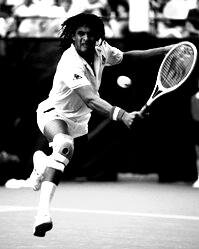 prove that his title in this year’s French Open was no fluke and that, like Wilander, he is improving on fast surfaces. Lendl, the second seed, defeated Florin Segarceanu, 6-2, 6-0, 6-2, in 83 minutes, and Noah, the fourth seed, who is troubled by tendinitis in his right knee, prevailed over Scott Davis, 6-1, 3-6, 7-6(2), 6-4, in a rain- interrupted match on the stadium court. Due to injury, Noah between his French Open triumph and US Open, played just one tournament, in Montreal where was defeated by Peter Fleming in the third round. One of the best matches of the day was produced by two unseeded players who have seen their best days as singles players. Ilie Nastase, at 37 the oldest man in the singles draw, rallied from two sets down, only to lose a fifth set tie-breaker, 7/3, to Peter Fleming. Fleming, who at No. 115 is eight places higher in the world rankings than Nastase, was on the verge of throwing away a lot of the hard work he had put into halting a three-year slide. Down by 2:4 in the final set, Fleming told himself, “All right, dig in. You’re about to be embarrassed by an old man.” The old man might have won, had it not been for a netcord shot that fell Fleming’s way at 3:3 in the tiebreaker. “Get over,” Fleming yelled, and won 7-6, 6-4, 2-6, 2-6, 7-6(3). It was the last 5-set match in career of Nastase, who perhaps has won the most 5-setters of all time. Aaron
 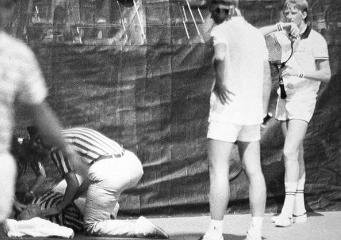 Krickstein, who turned 16 on August 2, recently won the national 18-and-under championship at Kalamazoo and earned himself a wild card into the U.S. Open. On Tuesday, the teenager from Grand Rapids, defeated French and Wimbledon junior champion Stefan Edberg of Sweden in a tense fifth-set tie-breaker. Krickstein, triumphed 6-3, 6-2, 3-6, 4-6, 7-6(3), thus became the second youngest male ever to win a match at the U.S. national championships (Jimmy Arias was 18 days younger in 1980). It was fifth main-level tournament for Krickstein (and his first win) and seventh for Edberg, who made 26 foot faults (record)! Other record of that meeting: the youngest average age (16 years 10 months 4 days). Eleven days later Edberg plays the final of the junior competition against Simon Youl, and one of his serves hits a groin a 61-year-old linesman, Richard Weirtheim. The man falls, hits the hardcourt with his head which causes bleeding in his brain and after five days unconscious, he dies…
Second round: Steve Goldstein
A beautiful late-summer’s day coupled with a full program of star attractions brought a single-session record crowd of 21,071 to the National Tennis Center at Flushing Meadow. They were treated to the best of the old and new that tennis has to offer. In the evening matches, second-seeded Ivan Lendl made short work of Shlomo Glickstein, 6-1, 6-1, 6-2, in 75 minutes. Earlier, John McEnroe had an unexpectedly easy time with John Sadri, demolishing the North Carolinian, 6-0, 6-1, 6-4. The top seed has never lost to Sadri, but the two have had some close encounters. McEnroe attributed his easy win to Sadri’s difficulty with his own usually potent serve. The New Yorker behaved impeccably during the match, and there were no incitements from the docile crowd. McEnroe acknowledged that he was consciously trying to control himself. “I want to play Davis Cup, and if I get another fine I won’t be able to,” McEnroe said. “I especially want to go to Ireland, and I think a lot of people are looking forward to it.” Among the other winners were seeded players Yannick Noah (4), Mats Wilander (5), Johan Kriek (12) and Steve Denton (13). Ninth-seeded Jimmy Arias rallied from 4:6 in a fourth-set tie-breaker to beat Tom Gullikson, 3-6, 6-3, 7-6(1), 7-6(7). How good Vitas Gerulaitis is at this point is debatable, but there is no doubt that the New Yorker gained a great deal of confidence in eliminating the troublesome Fritz Buehning, 3-6, 6-1, 7-6(6), 6-2. Last year at the Open, Gerulaitis, troubled by a mounting drug investigation – of which he was later exonerated – lost to Buehning in straight sets. The loser then executed one of 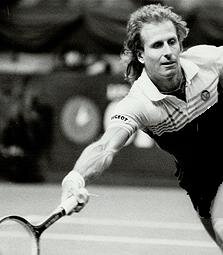 his more dazzling getaways in a series of rapid post-loss departures. After Buehning took the first set yesterday, it looked as if history might repeat itself. Gerulaitis was serving poorly (he finished with nine double faults), and Buehning was blasting low-percentage winners down the lines. But Gerulaitis picked up his game and Buehning, a rambling, bearlike 23-year-old from Summit, began missing with his passing shots. “He didn’t play as well as he did against me last year, and I played better,” Gerulaitis said later. “It wasn’t a great match. I don’t think either one of us was concentrating that well.” Gerulaitis gave Buehning plenty of chances to get back into the match. He squandered a 5:2 lead and two set points in the 3rd set, and after the set went to a tie-breaker, fell behind, 2:5. But Buehning double-faulted, and Gerulaitis followed with two winners to draw even, eventually winning the tie-breaker, 8/6, with an ace. But the best players consistently win the key points, as Arias demonstrated yesterday. Mats Wilander also demonstrated that he is not fazed by falling behind in a set, as he came back from 0:5 in the third set to complete a straight-set victory over Brian Gottfried, 6-3, 6-4, 7-6(3). Aaron Krickstein beat Scott Lipton of Belmont, Calif., 6-3, 6-1, 6-2, to move into the third round. “I didn’t think I’d get past the first round against Edberg,” said Krickstein, who lost to the Swede in the Wimbledon junior event. “Everything worked out better than I thought.” Krickstein has braces on his teeth, but his wicked forehand dispels any notion that this is merely a callow youth. He is weak in his serve and volley, though, and he freely acknowledges that clay is his best surface. Ranked No. 489 in the world, and suffering from strained ligaments in his right knee, Krickstein is concerned only with gaining experience at this point. His next opponent will be Gerulaitis. “I don’t know what he’s ranked,” Krickstein said of Gerulaitis. “I’ve never played anyone that good. But I’m not worried; I’ll just go out and do the best I can.”
Third round: Steve Goldstein
An amateur named Gregory Wayne Holmes made it look elementary yesterday in bouncing sixth-seeded Guillermo Vilas out of the U.S. Open. Holmes, 20, the 1983 NCAA singles champion from the University of Utah, who is ranked No. 453 in the world, employed a fierce attacking style reminiscent of Connors’ to score a shockingly one-sided 6-2, 6-2, 6-3 victory over the Argentine at the National Tennis Center. Jimmy Connors joined Holmes in advancing to the round of 16 with an easy 6-0, 6-4, 6-0 triumph over Bruce Manson. The winners could meet in the quarterfinals. Connors, the third seed, decided to go ahead with his match despite a telephone call indicating that his life might be in danger. At 1:15 p.m., a male caller told a staff member in the tournament manager’s office at the National Tennis Center that he had heard “on the street” that an attempt would be made on Connors’ life, according to Ed Fabricius, press director of the U.S. Tennis Association. Fabricius said “normal security measures” had been taken; he would not define them, except to say that New York City police were involved. Connors, waiting in the players’ dressing room to go out for his match, was informed of the call by John Smith, director of men’s professional tennis for the USTA. “I’m going to play,” Connors told Smith, and he went on court about an hour after the call was received. After the completion of his 77-minute match on the stadium court, the four-time U.S. Open champion immediately left the tournament site in Flushing Meadow, Queens. Two years ago, Bjorn Borg‘s life was threatened by a caller just before Borg took the court for the Open final against John McEnroe . No other such incidents during this tournament have been reported. Holmes’ next opponent will be 14th-seeded Eliot Teltscher, who defeated Anders Jarryd of Sweden, 6-7(5), 6-3, 6-2, 6-4. Other men who advanced to the round of 16 were Bill Scanlon, the 16th seed, Mark Dickson and John Lloyd, who won in five sets over American Terry Moor. One seed who did not make it was the 11th, Gene Mayer, who lost to Heinz Gunthardt of Switzerland, 6-1, 6-0, 6-0, in 66 minutes. Mayer held service in the third game of the opening set,  then meekly dropped the last 16 games. The night before his third-round match with Vitas Gerulaitis at the U.S. Open, Aaron Krickstein, 16, dreamed he lost in straight sets. “It was kind of weird,” said Krickstein, who was two-thirds of the way to defeat yesterday before reality took hold for both him and the 15th-seeded Gerulaitis. Krickstein then mounted an incredible comeback for one so young and inexperienced, rallying from 2:4 down in the final set and winning 12 of the last 15 points to oust Gerulaitis before 7,000 screaming fans packed into the grandstand court at the National Tennis Center. With the 3-6, 3-6, 6-4, 6-3, 6-4 triumph, Krickstein, of Grosse Pointe, Mich., the national boy’s 18-and-under champion who just turned 16 four weeks ago, became the youngest man to reach the final 16 of any of the four Grand Slam tournaments – French and U.S. Opens, Wimbledon, and the Australian Open – since 1968, when the open era of tennis began. “I didn’t do so well in my first few pro tournaments,” said Krickstein. At 3:3 in the fifth set against Edberg, Krickstein blasted four straight winners. He played the same kind of game against Gerulaitis, firing double- handed backhands from long range and displaying a powerful forehand worthy of Ivan Lendl. “I knew I had a chance after the third set,” Krickstein said. Serving at 4:2 in the final set, Gerulaitis had two game points to go 5:2, but he double-faulted on each. He then double-faulted to give Krickstein a break point, and the youngster followed with a cross-court backhand winner. Krickstein held serve at love for 4:4. Gerulaitis then lost his serve by double-faulting twice, the second time on the final point. With the crowd roaring, Krickstein served out the match, closing with a trademark backhand winner down the line. “Once it gets close and near the end of the match, I play my best,” the teenager said in understatement. Two other collegians on the verge of turning pro did not fare as well. Eric Korita, who last year took Yannick Noah to five sets before losing, yesterday managed only four sets against the French Open champion, though Noah thought his opponent played better this time. “I went out trying a little bit too hard,” the bullet-serving Korita said after the 5-7, 6-3, 6-3, 6-4 match. “I really wanted to win this one.” Jonny Levine of the University of Texas, a teammate of Korita’s on both the junior Davis Cup squad and the team that competed for the United States in the recent Pan-American games, was out-muscled by the second-seeded Ivan Lendl, 6-2, 6-2, 6-2. Both top-seeded John McEnroe and ninth-seeded Jimmy Arias moved into the final 16 without the loss of a set. McEnroe ‘s 6-1, 6-2, 6-1, 98-minute trouncing of Vincent Van Patten proved another showcase for McEnroe ‘s shot-making and his ability to avoid controversy when he wants to – or is compelled to by other circumstances, in this case an imminent suspension should he incur another $200 in fines. Johan Kriek defeated Roscoe Tanner 6-7(5), 3-6, 7-6(4), 7-6(3), 7-6(2) in the only 5-set match thus far, in which a winner won three consecutive tie-breaks.
Fourth round: Steve Goldstein
Top-seeded John McEnroe was beaten yesterday in the fourth round of the U.S. Open, the first time since 1977 that the 24-year-old New Yorker has failed to reach the semifinals of the Grand Slam event. McEnroe lost 7-6(2), 7-6(2), 4-6, 6-3 in 3 hours, 44 minutes by Bill Scanlon, 26, of Dallas, the 16th seed in the tournament. Scanlon had beaten McEnroe twice previously in small tournaments and suffered narrow losses to the world’s No. 1 ranked player in two major events, most recently at Wimbledon in June. “It’s very satisfying,” Scanlon said. “If you’re going to have a big win, what better than beating the No. 1 player in New York in the U.S. Open? It’s awfully satisfying.” McEnroe, who had won the Open in 1979, ’80 and ’81, did not play the kind of game expected of the best in the world. He had 10 double faults, and his first-serve percentage was a disappointing 51. He carped at some line calls early in the match, seemed troubled by the antagonism of the sellout crowd and generally never seemed to catch his rhythm. The loser also said he had been at a disadvantage in having to play two singles matches in less than 24 hours, a decision, 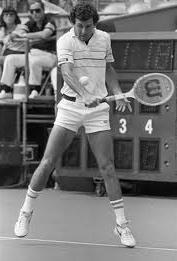 McEnroe said, dictated by the needs of a national television broadcast. But McEnroe said he wasn’t making excuses. “I’m not going to blame anybody – the scheduling committee, the umpires, the fans,” he said. “I’ve got no one to blame but myself. I expected a tough match today and I got it.” The crowd did become a factor in the match, disregarding umpire Ken Slye’s pleas for quiet in the final set. Earlier, two rowdy fans had been removed by security police. Asked whether he thought the fans got what they wanted, McEnroe said, ”Absolutely.” Adding to the drama of the upset was the animosity between the two players, clearly evident at times. Once friends, the pair have had a long-standing feud, and the match yesterday was punctuated by glares and stares and a ball whacked by McEnroe at Scanlon. The ball missed, and Scanlon replied by wagging a finger. In the end, as a backhand passing shot from Scanlon sailed past McEnroe and bounced on the court, the Texan hooted loudly and shot two fists into the air, baring a triumphant smile in the direction of Warren Jacques, his informal coach since the beginning of the year. Scanlon, who is ranked No. 17 in the world, moves into the quarterfinals against the unseeded Mark Dickson, who ended the stirring run by England’s John Lloyd, 6-7(8), 7-6(7), 6-0, 7-6(3). Dickson saved four set points in the second set that would have given Lloyd a two set to none lead. During one spectacular rally with 16-year-old Aaron Krickstein, Yannick Noah raced to retrieve a lob at the baseline and hit an implausible shot between his legs while winning the point. Asked if he practices the shot, Noah grinned and said, “Yeah, just for fun. If you’re playing five hours a day and it becomes boring, you try it.” Noah’s shot highlighted a relatively calm and true-to-form Tuesday at the U.S. Open tennis championships. Noah won 6-3, 7-6(2), 6-3. As temperatures soared to 93 degrees (36 Celsius) and smog practically obliterated the Manhattan skyline in the background, there were no tumultuous upsets such as top-seeded John McEnroe’s ouster by No. 16 Bill Scanlon the day before. No. 2 Ivan Lendl, now favored to win his first Grand Slam tournament, whipped No. 12 Johan Kriek, 6-2, 6-4, 6-1, in men’s fourth-round action. No. 5 Mats Wilander had an easy time beating Andres Gomez, 6-2, 6-1, 6-2, in one hour and 17 minutes. Wilander broke to a 4:1 lead in the opening set and won the first four games in each of the second and third sets. And No. 9 Jimmy Arias – like Krickstein, a teenage product of the Nick Bollettieri Tennis Academy in Bradenton, Fla. – rallied past Sweden’s Joachim Nystrom, 3-6, 6-3, 3-6, 6-0, 6-0.
I thought that I’d add this info because recently I had attached an entry about racquets… Players such as John McEnroe, Ivan Lendl and even semi-retired Bjorn Borg earn as much as $500,000 a year for endorsing a racquet. But Jimmy Connors doesn’t get a penny for playing with the Wilson T2000. Connors’ favorite racquet, a metal one with a round head and lots of power but little control, is a virtual dinosaur. No one else uses it on the pro tour, and it’s hard to find in stores. Now, Connors – who hasn’t had a racquet contract for two years – says he plans to switch, probably to a mid-size. “By the end of this year, I will be away from this racquet,” Connors said Wednesday. “They don’t make the T2000 like they originally did, not even for me. Now they use a different, thicker metal, and it doesn’t play the same. The racquets I am using are 10 years old. The ones I won Wimbledon and the U.S. Open with in 1974 are in my bag now. They are obsolete antiques, but I’ll put a few of them on my wall.” Connors said he has been using the T2000 for 18 years, first falling in love with it when he saw it at the Orange Bowl tournament in Miami Beach. “I liked the looks of it,” he added. “It was metal; it would shine; it wasn’t like wood.“
Quarterfinals: Jim Martz
“I’ve been through it. In ’74, when I played Rosewall in the finals, I couldn’t get the time of day in this town. In ’76, when I played Borg, it was the same thing. And in ’77, they wanted to kill me. But I had nobody to blame but myself. You control the feedback you get from the crowd. If you give ’em a hard time, they’ll give you a hard time. If you hit ’em in the face, they’re gonna hit you back.” said Jimmy Connors, who has mellowed since then and, not coincidentally, so has this town’s attitude toward him. Yesterday afternoon, there wasn’t a boo-bird in the joint during his 7-6(0), 6-2, 6-2 men’s singles quarterfinal victory over 14th- seeded Eliot Teltscher. Apparently everyone in this city isn’t behind Connors though. He received a death threat before his fourth-round match against Heinz Gunthardt of Switzerland earlier in the week. It didn’t seem to bother Connors though. He disposed of Gunthardt in straight sets, 7-5, 6-4, 6-1 And he had even less trouble with Teltscher, shutting him out in a first-set tie breaker and then wrapping up the next two sets in 49 minutes. Connors and Teltscher played a strange first set in which there were eight consecutive service breaks. But Connors swept through the tiebreaker, and had little trouble in the next two sets. “I wasn’t rusty,” Connors said. “It was windy, the most I’ve ever played in down here. On the one side, the ball went well, but on the other I just couldn’t keep it in. I played a good tiebreaker, and after that I think the wind died down, or I felt a little more confident.” It ran the third-seeded Connors’s career record over Teltscher to a perfect 11-0. Next obstacle for Jimbo is Bill Scanlon, a 3-6, 6-4, 4-6, 6-3, 7-6(4) winner over Mark Dickson in another quarterfinal match last night.
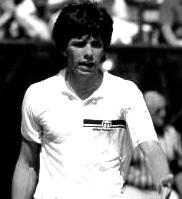 Jimmy Arias showed once again Thursday night that his boyish looks and slight build betray his macho forehand and maturity. In an entertaining match spiced by several circus-like shots and dazzling rallies, Arias jolted fourth-seeded Yannick Noah, 7-6(4), 4-6, 6-3, 1-6, 7-5, in the quarterfinals of the U.S. Open tennis championships. The 19-year-old Arias, seeded ninth, thus becomes the youngest male in the open tennis era (which began in 1968) to reach the semifinals here. “I’m ready, baby – throw me anything you’ve got.” Arias blurted as he bounced into the interview room seconds after walking off the court. “I played really well, and I think he probably was a little off his game. I won the big points.” There was just one break point – it was also match point – in the final set, and Arias won it by ripping a forehand return of Noah’s second service as the Frenchman charged the net. “I like to see things go to my forehand,” said Arias, who proved his ability on clay this year by winning the Italian and U.S. Clay Court championships. Now he’s trying to prove it on cement. “When I saw him serving to my forehand at match point, I thought, ‘God it’s my match if I don’t choke.'” Arias didn’t, but perhaps Noah did. He was up by 4:1 in the first set tie-break, but lost the lead when Arias won the last six points. “It doesn’t matter how many good or spectacular shots you hit if you don’t win,” said Noah. “I had a lot of chances but didn’t win the important points.” “I was much more aggressive today than I was in Cincinnati,” Ivan Lendl said about his 6-4, 6-4, 7-6(4) win over Mats Wilander, referring to a bitter loss (0-6, 3-6) he suffered to the Swede two weeks before. ”And he was making more mistakes. Today, I wanted to go full pace from beginning to end. And I was able to do it. I was upset with myself just once really, when he broke my serve at the beginning of the third set (Lendl was up 2:1 at the time). I didn’t want to go to a fourth set with him because he was getting stronger.” Lendl didn’t. With his forehand pumping out winner after winner, he held his serve the rest of the set and then took the tie breaker from Wilander.
Semifinals: Jim Martz
If Bill Scanlon‘s prognostication is accurate – and no one was questioning it Saturday – today’s match (4 p.m., Chs. 4, 34) between Jimmy Connors and Ivan Lendl for the U.S. Open men’s tennis championship should be an old-fashioned New York street fight. “They’ll just bash the ball back at each other, and whoever is hitting it harder and getting more in will win,” Scanlon said. “Jimmy is hitting the ball really well and really hard, and he’s stepping into everything. Some of my best shots I thought would go through him, but he just pounded back harder. I saw Ivan play in the semis this morning, and he’s hitting the ball well. It’s going to be a good final.” The same couldn’t be said for Saturday’s semifinals. The upstarts – Scanlon and Jimmy Arias – couldn’t cope with the established stars. Second-seeded Ivan Lendl dumped No. 9 Arias, at 19 the youngest semifinalist in 15 years of the open tennis era, 6-2, 7-6(3), 6-1. Then after the women’s final, third-seeded and defending champion Jimmy Connors beat No. 16 Scanlon, 6-2, 6-3, 6-2. Connors holds a 10-3 lifetime advantage over Lendl, including a four-set victory in last year’s Open final. But Lendl has won two of the three meetings since then in straight sets. Someone asked Lendl, who hasn’t lost a set in this Open, if he would finally win his first Grand Slam title. “There will be a first time tomorrow,” he said. “Either I’ll win 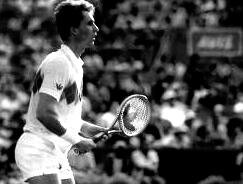 a Grand Slam or I’ll lose a set.” Connors, 31, is in his seventh Open final and is seeking his fifth championship. “I’ve always liked it here,” he said. “Let’s face it; somebody’s going to come in here and take my place eventually. I’m just trying to ward off the time between now and when that happens.” Arias survived five-set battles with Joakim Nystrom and fourth-seeded Yannick Noah in the last two rounds, but he came close only once to winning a set against Lendl. Arias had a triple set point against serve in the 9th game of the 2nd set, but Lendl escaped and won a tiebreaker after each had held serve. “I got a little tentative there, but he hit a lot of good shots,” Arias said. “I was confident even after I lost the second set. I was giving his serve trouble in every game, and I had break points in the first game. I had a call really bother me that game, and that kind of changed the momentum, because I started thinking about that bad call after I didn’t break that game.” Lendl struck 11 aces (54 in six matches en route to the final, 9.0 average) & 14 service winners vs Arias. Scanlon, who knocked top-seeded John McEnroe out of the tournament in the fourth round, never got close to a set point against Connors. “It’s frustrating,” Scanlon said. “I don’t feel like I ever got into it. I might have been a little nervous at the start, and he jumped on that and never let me play the kind of tennis I can.”
Final: Steve Goldstein
In a strange and error-filled championship match, Jimmy Connors yesterday won his fifth U.S. Open title by beating Ivan Lendl, who dramatically fell apart after double-faulting on a point that would have given the Czech a 2-1 lead in sets. Connors, 31, ran off the last 10 games against the dejected Lendl for a 6-3, 6-7(2), 7-5, 6-0 victory, clinching his first back-to-back Open titles. “It wasn’t quite as beautiful to look at as the others,” Connors said of the often sloppy, 3-hour, 5-minute match, “but the job was done.” Lendl, who looked nearly paralyzed in the final set, said simply: “I never really recovered from having a set point and double-faulting. If you make a mistake like that, you don’t really deserve to win.” On the strength of the quality of play, neither 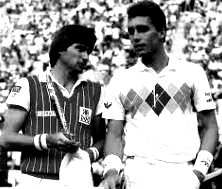 man deserved to win. Connors committed 51 unforced errors and Lendl 48. But Connors had the desire and the heart when it was needed, particularly with his blistering service returns in the third and fourth sets. As the loser would say later, “Nobody returns my serve better” than Connors. Lendl, meanwhile, waffled between the Tin Man and the Cowardly Lion. He looked opportunity full in the face and, invariably, he shut his eyes. Ivan, it must be said, was terrible. If the show wasn’t an artistic success, it certainly was a box-office smash, with nearly all the 20,575 in attendance raucously rooting Connors home. The triumph was Connors’ 100th tournament win, a record for men, and the winner’s check of $120,000 made Connors the first male player to exceed $5 million in prize money. Connors, who won Wimbledon and the U.S. Open in 1982, said at the beginning of ’83 that he hoped only for half as good a year. “This is the half,” he said last night. In 1982, Lendl thrashed Connors, 6-1 6-1, in an Open tuneup in Cincinnati, then lost in the Big One. Only four weeks ago, Lendl again beat Connors convincingly, 6-1 6-3, in Montreal. The Czech’s show seems to play well in the boonies, but it bombs when it gets to Broadway. Last year, an attack of nerves helped sabotage Lendl’s four-set loss to Connors in the Open final. Yesterday’s rematch was even more disastrous for Lendl, 23, who showed an inability to play the big points and a loss of mettle when things weren’t going his way. The word “choke” would not be inappropriate. Lendl, who set a single-year record in 1982 by winning more than $2 million in prize money and who has earned more than $4.2 million in his brief career – including $60,000 yesterday – will continue to be haunted by not having won a Grand Slam event. The sobriquet of “the player who can’t win the big ones” never seemed more apt. Lendl actually failed twice in key situations yesterday. The first occurred when Lendl served for the 2nd set at 5:3 (40/15) and lost his serve: both set points wasted with errors. A third set point came with Connors serving at 5:6, but the American saved it with an ace. Lendl won the tie-breaker convincingly, but, as he would say later, he expended much more energy in the 97-degree heat (36 Celsius) to win the set than he should have. That set also saw Connors leave the court after the 7th game, suffering with diarrhea. He returned after six minutes and was cautioned by Grand Prix supervisor Ken Farrar that another departure would result in a default. The rules allow three minutes only for injury or equipment repair. In the 3rd set, Lendl picked up his first-serve percentage, which had been well below 40 % during the first two sets. He lost his serve once but broke Connors’ twice and, at 5:4, was serving to take a two-sets-to-on e lead. After Connors squandered a break point with a long forehand approach shot, Lendl
 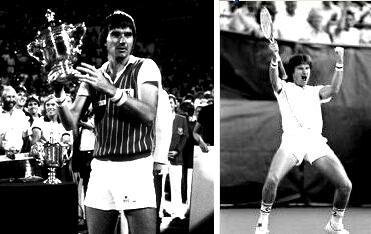 got a set point with a forehand winner. Then came his second failure in a key situation. His first serve was long. His second plunked into the net as the crowd let loose with a huge roar/gasp. “The wind got a little hold of my toss,” Lendl said. “I should have caught the ball and tossed it again.” But the enormity of the moment was yet to be realized. Connors took the next point with a forehand volley placement, then broke Lendl with a backhand volley winner. Having saved the set, Connors let loose with one of his patented wild-man displays of euphoria, screaming and pumping his fists. “My spirits lifted about 50-60 percent, and I think his dropped a little from that point,” Connors said. “He played a pretty awful game to lose the set.” After Connors held for 6:5, Lendl fell behind 15/40 on his own serve. He saved one set point when Connors missed a backhand, but the second chance saw Lendl net a forehand, and the Czech’s worst fears had been realized. “I never recovered from that,” Lendl said again. “I just felt mentally down after double-faulting.” Connors sensed it, too, the way a shark smells blood, and he moved in for the kill. “In the fourth set, I tried to jump on everything and get on top right away,” Connors said. He held his own serve, then broke Lendl’s as the Czech missed two easy backhands. “He kind of sank at that point,” Connors said. ”I played a pretty good point to hold my serve and go up 3:0 and just tried to concentrate to hold on there.” Connors had the edge right there, for Lendl wasn’t concentrating at all. While Connors moved freely, Lendl looked as if a traffic cop had attached the infamous “boot” to his leg. In the final game, Lendl didn’t put up much of a fight. True, he saved two match points with two aces – the latter his 17th. But on the third match point, Connors hit a forehand service return that fell for a winner. Lendl didn’t even budge, as if he were tired of prolonging his agony. Connors raised his arm in triumph. His 100th title – the first man to break this mark (eighth and last major title)! Stats of the final

Matches on YT:
1982
Connors vs. Vilas
Lendl vs. McEnroe
Connors vs. Lendl
1983
Connors vs. Lendl