Rainer Schüttler
Born: April 25, 1976 in Korbach (Heßen)
Height: 1.79 m
Plays: Right-handed (two-handed backhand)
Schüttler had four match points (7-6, 2-6, 6-8) in the third round of the 1994 Australian Open juniors against local favorite Mark Philippoussis, but during his early professional years, it would have been difficult to imagine him coming within a point of a Grand Slam quarterfinal – he was losing in the first round of qualifying events at majors. That changed dramatically in Doha 1999: Schüttler not only claimed his first ATP title as a qualifier, but also defeated three Top 20 players in 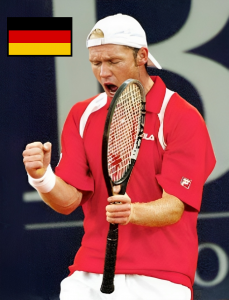 succession. That success allowed him to bypass qualifiers and play directly in ATP tournaments after a three-year struggle collecting points on the Challenger circuit.
The 2003 Australian Open defines Schüttler’s status in tennis history. The German unexpectedly reached the final where he was severely beaten by Andre Agassi, whom the German called “the toughest opponent he ever played against” – the shocking success was slightly allowed by Marat Safin’s withdrawal in the third round – but calling him a fluke finalist would be unfair. He beat David Nalbandian (QF) and Andy Roddick (SF) in back-to-back matches.
“During the two weeks, I didn’t think too much,” Schüttler recalled. “I was playing match-by-match, I was trying to go on court and play as well as I can. One memory that stands out is when I won a match point in the semi-finals against Roddick. I felt how cleanly I hit the backhand down the line to win the match. It was unbelievable during the night session, the stadium was full. The spectators were on their feet for a standing ovation.” Schüttler’s backhand down the line may be considered as his best shot.
He primarily based his game on excellent physical fitness, being a typical grinder with a never-say-die attitude, yet he didn’t like to operate far behind the baseline during rallies. Following his sensational run in Melbourne, Schüttler maintained high-level form for over a year, reaching semifinals in top tier events (Indian Wells, Montreal, Cincinnati, Houston), capturing back-to-back titles on two surfaces (Tokyo and Lyon), and contesting another big final on his least favorite surface – clay, Monte Carlo (2004). But after that tournament, at age 28, he began struggling to win three consecutive matches, it lasted several years but he remained patient still believing in a miracle which ultimately happened in 2008…
He announced his retirement in October 2012, having played his last pro matches (five in qualifying rounds in Qatar & Australia) ten months earlier: “I played my last match in January and due to a groin injury and fitness problems I have decided to retire. I would have liked to have played in the London Olympics at Wimbledon this summer, but I will now concentrate on future projects.”
Besides the Australian Open final, Schüttler had two other career highlights in his long 17-year journey: the Olympic doubles final in 2004, where he and Nicolas Kiefer squandered four match points, and the Wimbledon 2008 semifinal. That year, he seemed finished – ranked No. 94, aged 32, and enduring the longest main-level losing streak of the season (8) – but his risk-taking style paid off in the fortnight. He won five matches, including a quarterfinal marathon over Arnaud Clément in which he saved a match point – one of a few Wimbledon matches that lasted more than five hours.
Trivia: Schüttler was bagelled twice in his career: first in Tokyo 1998 by Jan-Michael Gambill, then at the 2009 World Team Cup by Robin Söderling. A few days after the Söderling humiliation, he suffered a brutal first-round loss at Roland Garros: 0-6, 0-6, 4-6 to Marc Gicquel. Yet, astonishingly, after that clay-court slump, he switched to grass and nearly reached the final in the Netherlands, losing to Benjamin Becker – the man who had ended Agassi’s career at the 2006 US Open. As a player born in the mid-1970s, the German experienced two distinct eras of tennis and managed to defeat all the greatest players of his time except Pete Sampras – though they met only twice.
Career record: 327–337 [ 329 events ]
Career titles: 4
Highest ranking: No. 5
Best GS results:
Australian Open (runner-up 2003)
Wimbledon (semifinal 2008)
This entry was posted in
Players. Bookmark the
permalink.


Activity: 1995 – 2011
Five-setters: 8–7 (53%)
Tie-breaks: 119–129 (48%)
Deciding 3rd set TB: 11-13 (46%)
Defeats by retirement: 10
Walkovers given: 2
Longest victory: Wimbledon ’08 (QF)… Arnaud Clement 6-3, 5-7, 7-6, 6-7, 8-6… 5 hours 12 minutes
Longest defeat: US Open ’01 (1R)… Ramon Delgado 4-6, 7-6, 6-7, 6-2, 2-6… 3 hours 51 minutes
MP matches: 4-3
Two-point away matches: 3-8