Emilio Sánchez Vicario
Born: May 29, 1965 in Madrid
Height: 1.80 m
Plays: Right-handed
It’s difficult to explain why the older brother Emilio achieved much more than the younger Javier Sánchez (b. 1968 in Pamplona, the best junior of 1986). Unlike the McEnroe brothers, who had completely different personalities and game styles – and a larger age gap (John was seven years older than Patrick), placing them in different tennis eras (John was a transitional player between wooden and steel/aluminium racquets) – the Sanchez brothers played at the same time, facing the same opponents. Their 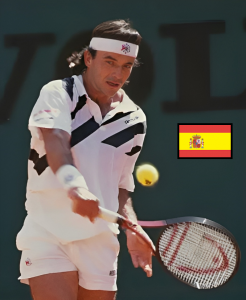 game styles were almost identical and suited to what, in the 1980s, could be described as the “Spanish school” – one-handed backhands, plenty of slices, clay as their natural habitat, and solid overall technique that allowed them to apply serve-and-volley tactics when needed.
Emilio had something indefinable – something that helped him beat players who were, on paper, superior. He defeated Ivan Lendl, Boris Becker, and Stefan Edberg – the best players during his prime – while Javier lost to all of them in every encounter. A curiosity about Javier: he lost to Edberg twice with the same scoreline (6-2, 6-7, 2-6); first in Stuttgart ’92, where he blew two match points, and a year later in Monte Carlo, being two points from victory again.
Javier may have envied his older brother – he copied him in everything – yet it wasn’t enough to match his ranking or win a title of the same caliber (Emilio’s biggest title was Rome ’91). At least when it came to Grand Slams, they were on equal footing – two quarterfinals each. Surprisingly, both of Javier’s Slam quarterfinals came in New York (1991 and 1996), rather than Paris, which seemed more likely given his style. Emilio, in both of his major quarterfinals (1988), was stopped by Mats Wilander – then the best player in the world – after almost identical matches: 7-6, 6-7, 3-6, 4-6 in Paris, and in New York City 6-3, 6-7, 0-6, 4-6, blowing set points in both matches to lead two sets to love. Interestingly, these matches followed a pattern they’d already established at Wimbledon in 1987, when Wilander prevailed 2-6, 7-6, 6-3, 7-5.
Emilio first showed he was a serious force on clay courts at Rome 1986, reaching the final and playing a competitive match against the world’s best, Lendl. Two years later, he proved himself dangerous on hard courts too, reaching the final at Indian Wells. The years 1990-91 were the peak of his career. He began that stretch by winning the Hopman Cup for Spain alongside his sister Arantxa Sanchez, including a dramatic win over John McEnroe (who have beaten Emilio in two tight five-setters in Slam fourth rounds).
Before claiming the biggest title of his career in Rome, Emilio had already captured one of the most important titles for any Spanish player – Barcelona – defeating compatriot Sergi Bruguera. Had Sanchez and Bruguera both played their best tennis at the same time, they could have led Spain to a Davis Cup final. That never happened, though, as Bruguera’s rise coincided with Sanchez’s decline. Still, they did help Spain win the World Team Cup in 1992, with Sanchez winning all four of his singles matches – three of them from the brink of defeat, and all against top opponents.
Later that year, Sanchez and Bruguera met in the Palermo final, marking the beginning of the end for Sanchez, who from then on started losing more regularly. One more noteworthy result followed: a semifinal in Hamburg, where he nearly beat local favorite Michael Stich.
Sanchez remains one of the most successful doubles players ever to reach the Top 10 in singles. He won 50 doubles titles (including three Slams), the vast majority of them with Sergio Casal. The duo also won a silver medal at the Seoul Olympics. Many years after retiring from professional tennis, he returned to the circuit as Spain’s Davis Cup captain and led the team to victory in 2008, capturing the prestigious trophy despite the absence of Rafael Nadal in the final.
Career record: 431–291 [ 287 events ]
Career titles: 15
Highest ranking: No. 7
Best GS results:
Roland Garros (quarterfinal 1988)
US Open (quarterfinal 1988)
World Team Cup 1992 champion
Hopman Cup 1990 champion
This entry was posted in
Players. Bookmark the
permalink.


Activity: 1984 – 1997
Five-setters: 13–16 (44%)
Tie-breaks: 130–131 (49%)
Deciding 3rd set TB: 11-10 (52%)
Defeats by retirement: 0
Walkovers given: 2
Longest victory: French Open ’92 (2R)… Wally Masur 3-6, 5-7, 6-3, 6-4, 13-11… 4 hours 46 minutes
Longest defeat: Aussie Open ’92 (4R)… John McEnroe 5-7, 6-7, 6-4, 6-2, 6-8… 4 hours 42 minutes