Radek Štěpánek
Born: November 27, 1978 in Karviná (Moravskoslezský kraj in Czechoslovakia)
Height: 1.85 m
Plays: Right-handed (two-handed backhand)
“How do you feel after winning the title at the end of your career?” Fred Stolle, one of the best players in the mid 60s, asked 30-year-old Štěpánek courtside when the Czech triumphed in Brisbane 2009. “It’s not the end, it’s the beginning,” replied the fresh champion. It was amusing, not true, but also not far from what Stolle might have sarcastically expressed in response: “Maybe the beginning of the end.” In January 2009 Štěpánek was more or less in the middle of his career, and the best was still to come. That same 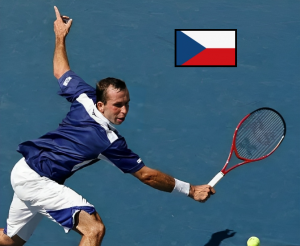 year he helped Czechia (the Czech Republic name still in official usage then) advance to the Davis Cup final in Barcelona, where he lost what was at the time the most important – and brutal – match of his career to David Ferrer, despite sensationally destroying the Spaniard in the first two sets (6-1, 6-2). Something like that was almost unimaginable. Štěpánek was two points away from winning the second rubber as he led 5:4 (30-all) in the decider. Spain eventually won the tie 5-0, and Štěpánek could have realistically thought that a match of such magnitude would be impossible to repeat in his career.
But his Davis Cup destiny turned out to be far brighter than anyone could have expected. He became one of the few players in the Open Era to win two Davis Cup clinchers, doing so in consecutive seasons: first in Praha 2012, where he survived a complex four-setter against Nicolás Almagro, and then the following year in Belgrade, where he faced novice Dušan Lajović and defeated him with ease – arguably the most one-sided Davis Cup clincher of the first two decades of the 21st century.
I remember seeing Štěpánek for the first time at the US Open 2002 doubles semifinal. Partnering Jiří Novák, he advanced to the final and was kissing his partner in celebration. It seemed clear that Štěpánek had an inclination toward atypical behaviour, but at 24 he was still largely unknown in singles and could have been perceived as another doubles specialist. That year he played plenty of singles too, entering eleven qualifying events and advancing ten times to the main draw, with two semifinals on clay. Petr Korda, the former no. 2, was his adviser at the time. Štěpánek used to play his forehand shots with the eastern grip, the technique already out-dated in the first decade of the new millennium, yet in his case profitable even in the next decade.
The 2003 Australian Open was a turning point: in the second round he defeated a declining yet still dangerous Gustavo Kuerten in five sets before being overwhelmed on Centre Court by Lleyton Hewitt. Even so, he felt he belonged to a broader elite in singles, not just doubles. For the next 14 years he regularly played majors – 55 appearances in all – yet reached just one quarterfinal. Given his two Masters 1000 finals, he might have expected at least one Slam semifinal, but it never happened; at Wimbledon he held a match point against Jonas Björkman to win 3-1 in sets, but couldn’t convert.
Štěpánek was an all-court player with a slightly better backhand than forehand. His forehand was somewhat old-fashioned, but flat and precise, he knew hot to use it for well-masked dropshots. Flexible and tactically astute, he could suddenly switch from defence to offence, with great touch and variety that made him enjoyable to watch on all surfaces – even clay, despite a lack of heavy top-spin. One of his two Masters 1000 finals came on clay (Hamburg 2006) in the unusual circumstances when Rafael Nadal and Roger Federer withdrew after their epic Rome final the previous week. Two years before he had played a Masters 1K final in Paris. The Czech shot-maker seized his opportunity in advancing to the most important finals of his career, eliminating slightly inferior players in the semi-finals in Paris and Hamburg. As someone with two finals at this level, he was destined to get at least one ATP 500 title – he won two (Rotterdam, Washington).
Trivia: his Davis Cup match against Ivo Karlović in 2009 (semifinal) could have been the first all-tie-break five-setter if the two-game advantage in the decider had not still been required. Štěpánek survived after six hours, saving match points in total, at 4:5 and 11:12.
Career record: 384–302 [ 289 events ]
Career titles: 5
Highest ranking: No. 8
Best GS result:
Wimbledon (quarterfinal 2006)
Davis Cup champion 2011-12
This entry was posted in
Players. Bookmark the
permalink.


Activity: 1998 – 2017
Five-setters: 15–24 (38%)
Tie-breaks: 162–150 (51%)
Deciding 3rd set TB: 16-18 (47%)
Defeats by retirement: 12
Walkovers given: 2
Longest victory: Davis Cup ’09 (SF)… Ivo Karlovic 6-7, 7-6, 7-6, 6-7, 16-14… 5 hours 59 minutes
Longest defeat: US Open ’07 (2R)… Novak Djokovic 7-6, 6-7, 7-5, 5-7, 6-7… 4 hours 41 minutes
MP matches: 5-8