Magnus Norman
Born: May 30, 1976 in Filipstad (Värmland)
Height: 1.88 m
Plays: Right-handed (two-handed backhand)
Norman, born into a family of professional athletes, was seen as a potential successor to Sweden’s greatest players. Already as a 16-year-old – before even entering junior tournaments – he received a wild card for Stockholm qualifying and, despite being unranked, defeated three players, including Peter Lundgren, a former world no. 25 who was eleven years older. Although Norman was thrashed in the first round by Derrick Rostagno, the ATP debut was exceptionally promising.
The next two years were tough: Norman competed in Satellites and Challengers, with almost three years separating his 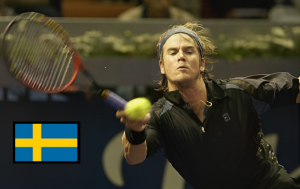 first two ATP appearances. Even though he didn’t establish himself as another Björn Borg, Mats Wilander, Stefan Edberg, or even Thomas Enqvist, he gained recognition in the late 1990s as a dangerous floater. His breakthrough came at Roland Garros 1997, where he advanced to the quarterfinal having ousted Pete Sampras in the third round – still a huge result at the time, even if Sampras was already past his clay peak. In the French Open – Wimbledon stretch of 1997, Norman showed great mental toughness, winning epic five-setters against the two fastest left-handed servers on tour: 9-7 in the 5th against Greg Rusedski in Paris, and 14-12 in the 5th versus Goran Ivanišević at Wimbledon (saving four mini–match points at 11-all). In that latter match, Norman began experiencing heart problems, and in December 1997 he underwent a five-hour surgery to correct an irregular heart rate.
The surgery delayed his rise, and he slumped during 1998 – though he did contribute significantly to Sweden’s Davis Cup title. In the first round he won a 4th rubber against Karol Kučera in five sets when Sweden was a few games from being eliminated, and opened the final against Italy with a thrilling win over Andrea Gaudenzi in extremely lucky & dramatic circumstances. That Davis Cup success launched the most successful stretch of Norman’s career.
In 1999, he won five ATP titles (Orlando, Stuttgart, Umag, Long Island, Shanghai), that year as many as the two greatest players of the 90s, though underwhelming results at the majors kept him out of the Top 10. The following year, 2000, was the peak of his career. With Sampras and Andre Agassi nearing the end of their rivalry, Norman briefly emerged as a contender for the world no. 1 ranking, having defeated young players who seemed to be potential rulers of the 2000s, in Melbourne & Paris. He didn’t have any weapon that would allow him to win matches, his movement was rather clumsy, but he had a strong serve and solid flat shots from both wings, using them wisely, moreover he was super clutch at tight situations during his two excellent seasons. He admitted that since his junior days he had kept a journal in which he wrote down which specific shots work against particular players… In the spring of that most fruitful year, he reached the final stages of three biggest clay-court tournaments, facing Gustavo Kuerten in all three: he beat Kuerten in the Roman final, lost in the Hamburg quarterfinals, and then played an unforgettable final in Paris.
That Roland Garros match is arguably the most dramatic four-set Slam final ever. Norman won the third set and saved 10 match points in the fourth before finally losing it. The quality of play and emotional intensity were extraordinary. During the trophy ceremony, Norman visibly blinked uncontrollably, suggesting he was still overwhelmed by nerves. It’s possible that this match – more than any other – determined that Kuerten, not Norman, ended the year ranked no. 1.
From there, Norman’s career entered a slow decline. Though still dangerous in 2001-02, he never recaptured the aura he had in 1999-00, not being able to get another title. In 2003, his career collapsed. Battling knee and hip issues that had required surgery, still worried about his heart, he lost ten consecutive matches (excluding qualifying), including a 1-6, 3-6 defeat to Greek journeyman Konstantinos Economidis. His four-hour first-round loss at the 2003 US Open to Jean-René Lisnard was particularly painful: after escaping a straight-set loss and holding a match point at *5:3 in the 5th, he lost the set 6-7. Prior to that blow, for a long time he was always winning while serving for the match. Norman entered just two more events after that disaster before announcing his premature retirement.
After hanging up his racquet, Norman built a new career as one of the most respected coaches on tour. He helped Robin Söderling reach two French Open finals and later guided Stan Wawrinka from a Top 20 player without any significant titles into a multiple Grand Slam champion.
Career record: 244–177 [ 174 events ]
Career titles: 12
Highest ranking: No. 2
Best GS results:
Australian Open (semifinal 2000)
Roland Garros (runner-up 2000; quarterfinal 1997)
Davis Cup 1998 champion
This entry was posted in
Players. Bookmark the
permalink.


Activity: 1992 – 2003
Five-setters: 9–8 (53%)
Tie-breaks: 91–75 (54%)
Deciding 3rd set TB: 6-6 (50%)
Defeats by retirement: 7
Walkovers given: 0
Longest victory: Davis Cup ’98 (F)… Andrea Gaudenzi 6-7, 7-6, 4-6, 6-3, 6-6 ret.… 4 hours 58 minutes
Longest defeat: Aussie Open ’98 (1R)… Sebastien Lareau… 4-6, 7-6, 6-7, 7-6, 5-7… 4 hours 10 minutes
MP matches: 7-3