Points won by each set: | 32-37, 36-26, 27-14, 25-32, 30-24 |
Points won directly behind the serve:
34 % Becker – 47 of 136
30 % Edberg – 45 of 147
The first edition of the Belgian American Young Masters, an event for 16 best players aged 21 or younger for the year 1984 (Nystrom & Giammalva, born in 1963, were the oldest participants while Becker & Krickstein, both born in 1967, the youngest). It was held on carpet indoors, in the first week of 1985 in Birmingham (England). The entire 80s it was an unprecedented decade in the history of tennis, never before or after so many teenagers were successful in men’s circuit due to transition from wooden & aluminium racquets to the modern graphite equipment. At the end of 1984 as many as seven players in the Top 20 were aged 21 or younger! Edberg ranked no. 20, was seeded with no. 6 in Birmingham. In the final he faced the unseeded Becker [66], nearly two years his junior to whom had never lost a set before ☆, not being even pushed to 5-all, and he continued that streak winning the opener from 4:3* down. At 2:3 in the 2nd set Edberg led 30/0 on serve, but was broken for the first time, and it made a negative impact on him; he retreated from his regular serve-and-volley style, and for the rest of the final he was constructing the majority of points on serve from the baseline. The 17-year-old Becker continued attacking the net, being more aggressive in baseline exchanges, at one junction he had won 10 out of 11 games… led 3:0* in the 4th set but lost his focus and five straight games. Edberg wasted a double break point in the first game of the deciding set, and lost his serve at 3:4 when the linesman called ‘foot fault’ on his second serve (a fourth time in the final). Becker fired two aces in the last game of the 2-hour 40-minute final, and received a check for $18,000, Edberg got $12,000. The final of two northern Europeans wasn’t accidental, they both claimed their first major titles in 1985 becoming the top players for the rest of the decade, and eventually at the turn of the 80s and 90s they were the best in the world.
Becker’s route to the title:
1 Aaron Krickstein 6-3, 6-1
Q Ricky Brown 6-3, 6-4
S Sammy Giammalva 7-6, 6-3, 6-3
W Stefan Edberg 4-6, 6-3, 6-1, 4-6, 6-3
☆ The rule of the tie-break in deciding sets applied for all the matches
☆☆ That final meant a lot in terms of their rivalry. Prior to the Birmingham encounter, Becker had Edberg’s complex losing four times quickly. In 1983 they met twice in junior events: Edberg won 6-2, 6-4 at Wimbledon, and 6-2, 6-2 at other occasion, the Swede also won 6-2, 6-4 their Satellite match. In 1984 they faced each other in Köln (their first main-level meeting) where Edberg confirmed his superiority with a 6-4, 6-4 decision. So after the first set in Birmingham, Edberg led 9:0 in their sets not being threatened once. A few weeks after Birmingham, it seemed that everything would return to normal between them as Edberg defeated Becker 6-3, 6-1 in Philadelphia; in March ’85 they played their first match in doubles as opponents, and Edberg found himself in a winning pair… Ultimately their official H2H (not counting four out of six matches mentioned above) would be finished at 25-10 for Becker (3-3 in doubles) in 1996 when Edberg retired.
When they met in Birmingham, Edberg had played 33 main-level events (1 title), Becker 12.
The best Grand Slam result was the same for them both: Australian Open ’84 quarterfinal.

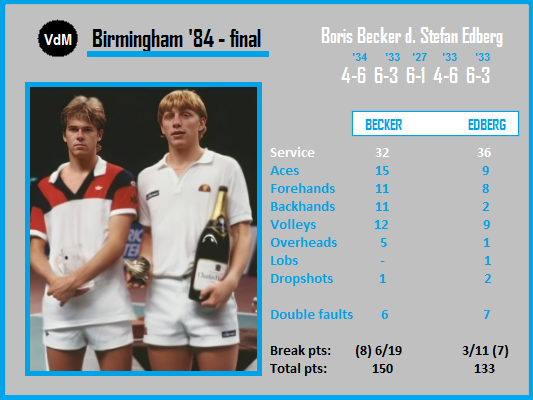
Points won by each set: | 32-37, 36-26, 27-14, 25-32, 30-24 |
Points won directly behind the serve:
34 % Becker – 47 of 136
30 % Edberg – 45 of 147
The first edition of the Belgian American Young Masters, an event for 16 best players aged 21 or younger for the year 1984 (Nystrom & Giammalva, born in 1963, were the oldest participants while Becker & Krickstein, both born in 1967, the youngest). It was held on carpet indoors, in the first week of 1985 in Birmingham (England). The entire 80s it was an unprecedented decade in the history of tennis, never before or after so many teenagers were successful in men’s circuit due to transition from wooden & aluminium racquets to the modern graphite equipment. At the end of 1984 as many as seven players in the Top 20 were aged 21 or younger! Edberg ranked no. 20, was seeded with no. 6 in Birmingham. In the final he faced the unseeded Becker [66], nearly two years his junior to whom had never lost a set before ☆, not being even pushed to 5-all, and he continued that streak winning the opener from 4:3* down. At 2:3 in the 2nd set Edberg led 30/0 on serve, but was broken for the first time, and it made a negative impact on him; he retreated from his regular serve-and-volley style, and for the rest of the final he was constructing the majority of points on serve from the baseline. The 17-year-old Becker continued attacking the net, being more aggressive in baseline exchanges, at one junction he had won 10 out of 11 games… led 3:0* in the 4th set but lost his focus and five straight games. Edberg wasted a double break point in the first game of the deciding set, and lost his serve at 3:4 when the linesman called ‘foot fault’ on his second serve (a fourth time in the final). Becker fired two aces in the last game of the 2-hour 40-minute final, and received a check for $18,000, Edberg got $12,000. The final of two northern Europeans wasn’t accidental, they both claimed their first major titles in 1985 becoming the top players for the rest of the decade, and eventually at the turn of the 80s and 90s they were the best in the world.
Becker’s route to the title:
1 Aaron Krickstein 6-3, 6-1
Q Ricky Brown 6-3, 6-4
S Sammy Giammalva 7-6, 6-3, 6-3
W Stefan Edberg 4-6, 6-3, 6-1, 4-6, 6-3
☆ The rule of the tie-break in deciding sets applied for all the matches
☆☆ That final meant a lot in terms of their rivalry. Prior to the Birmingham encounter, Becker had Edberg’s complex losing four times quickly. In 1983 they met twice in junior events: Edberg won 6-2, 6-4 at Wimbledon, and 6-2, 6-2 at other occasion, the Swede also won 6-2, 6-4 their Satellite match. In 1984 they faced each other in Köln (their first main-level meeting) where Edberg confirmed his superiority with a 6-4, 6-4 decision. So after the first set in Birmingham, Edberg led 9:0 in their sets not being threatened once. A few weeks after Birmingham, it seemed that everything would return to normal between them as Edberg defeated Becker 6-3, 6-1 in Philadelphia; in March ’85 they played their first match in doubles as opponents, and Edberg found himself in a winning pair… Ultimately their official H2H (not counting four out of six matches mentioned above) would be finished at 25-10 for Becker (3-3 in doubles) in 1996 when Edberg retired.
When they met in Birmingham, Edberg had played 33 main-level events (1 title), Becker 12.
The best Grand Slam result was the same for them both: Australian Open ’84 quarterfinal.