Points won by each set: | 27-21, 41-42, 28-32, 36-31 |
Points won directly behind the serve:
36 % Martin – 48 of 131
25 % Karbacher – 32 of 127
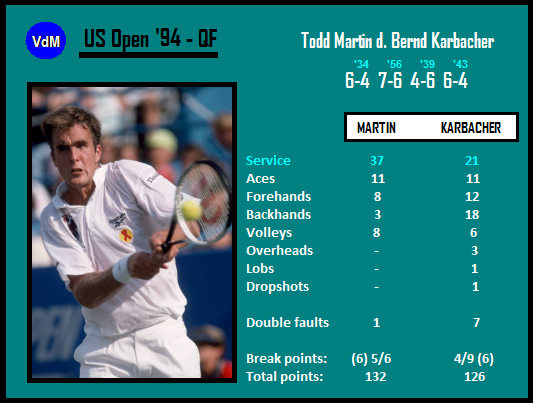
Karbacher [41] had quickly won the opening two games, and afterwards he was awful for nearly 50 minutes, not being able to cope with the strong wind. Martin led 6-4, 3:0* (15/0) while Karbacher was keeping his serve at ridiculously low 20% in (finished at 45%), five double faults were counted for him. The German held though with three successive winners when the ball landed on the lines, and suddenly he was a different player from that game to the end of the match, usually outplaying his opponent in baseline exchanges. Especially the tie-break was intriguing and could have shifted the momentum because at the time, after 3/4 of the season, ☆ Karbacher had the best TB record on tour (Martin didn’t play tie-breaks bad either in 1994), but he was serving a bit worse than the American, and lost that tie-break 5/7. The only break of the 3rd set occurred as Karbacher led 5:4. In the 4th set Martin [9], not showing any emotions throughout that quarterfinal, led 4:2, Karbacher levelled at four games apiece. In the 9th game, Karbacher played two forehands so close to the same sideline that in both cases there would have been winners, it was still more than a decade before “challenges”, Karbacher’s strokes were called out, and he was broken at 30. Martin finished the 2-hour 52-minute contest with a forehand winner. Their next two matches wins Karbacher. Thanks to his first major quarterfinal, Karbacher was elected by Niki Pilic for the Davis Cup semifinal against Russia in Hamburg where he lost in four sets to Kafelnikov.

Points won by each set: | 27-21, 41-42, 28-32, 36-31 |
Points won directly behind the serve:
36 % Martin – 48 of 131
25 % Karbacher – 32 of 127
Karbacher [41] had quickly won the opening two games, and afterwards he was awful for nearly 50 minutes, not being able to cope with the strong wind. Martin led 6-4, 3:0* (15/0) while Karbacher was keeping his serve at ridiculously low 20% in (finished at 45%), five double faults were counted for him. The German held though with three successive winners when the ball landed on the lines, and suddenly he was a different player from that game to the end of the match, usually outplaying his opponent in baseline exchanges. Especially the tie-break was intriguing and could have shifted the momentum because at the time, after 3/4 of the season, ☆ Karbacher had the best TB record on tour (Martin didn’t play tie-breaks bad either in 1994), but he was serving a bit worse than the American, and lost that tie-break 5/7. The only break of the 3rd set occurred as Karbacher led 5:4. In the 4th set Martin [9], not showing any emotions throughout that quarterfinal, led 4:2, Karbacher levelled at four games apiece. In the 9th game, Karbacher played two forehands so close to the same sideline that in both cases there would have been winners, it was still more than a decade before “challenges”, Karbacher’s strokes were called out, and he was broken at 30. Martin finished the 2-hour 52-minute contest with a forehand winner. Their next two matches wins Karbacher. Thanks to his first major quarterfinal, Karbacher was elected by Niki Pilic for the Davis Cup semifinal against Russia in Hamburg where he lost in four sets to Kafelnikov.
Serve & volley: Martin 9/22, Karbacher 1/1
☆ The best tie-break records by percentage in 1994 (at least 20 played):
1. Eltingh… 77% (33-10)
2. Karbacher… 77% (20-6)
3. Sampras… 73% (29-11)
4. Rosset… 70% (28-12)
5. Chang… 70% (19-8)