Points won by each set: | 33-20, 30-22, 27-15 |
Points won directly behind the serve:
32 % Enqvist – 25 of 76
33 % Gustafsson – 19 of 71
Even though they both were playing mainly from the baseline, it was a super quick final because neither of them enjoyed long rallies, each of them loved dictating the pace with a huge forehand therefore rallies constructed of six strokes or more were a rarity in that final. Enqvist [7] established his supremacy in each set at the beginning: he led 3:0, 3:1 and 4:0 respectively, and finished the event with an ace out-wide. He raised his both arms in victory gesture, then showed three fingers in his left hand – it was his third title at the Stockholm Open within five years making him the most successful player in tournament’s history behind J.McEnroe and Becker who collected 4 titles each. For the 32-year-old Gustafsson [68] it was the penultimate final in his long career (one of the longest careers given players born in the 60s). He finished it with a 14-12 record, he waited ten years to play his second final in Stockholm.
Enqvist’s route to his 16th title:
1 Fernando Vicente 6-0, 6-1
2 Jens Knippschild 6-2, 6-1
Q Andreas Vinciguerra 6-2, 6-7(6), 6-4
S Magnus Norman 6-3, 6-4
W Magnus Gustafsson 6-3, 6-4, 6-2
☆ Enqvist was playing tennis of his life when he was 25, speaking more precisely the best at the beginning and the end of 1999. After a title in Stuttgart (one of the most impressive routes to the title given the potential of five defeated opponents), he advanced to the third round in Paris playing three tight matches against very good opponents, and after a few days of rest he claimed the Stockholm title. It put him among the main favorites to win Masters in Hannover which would be the biggest title of his life; he was two games away from reaching the semifinal already after his second round robin match, but lost to Kafelnikov (5-7, 6-3, 4-6) and didn’t advance further being upset by Todd Martin in his last group encounter.

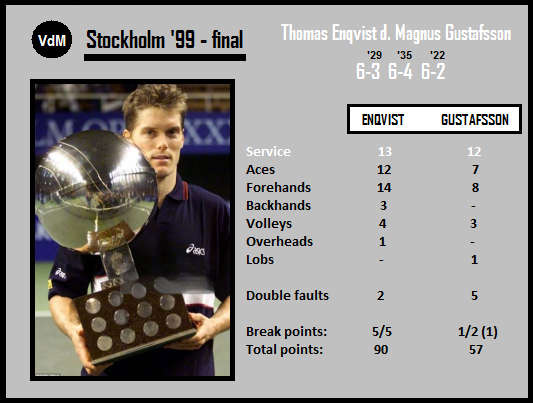
Points won by each set: | 33-20, 30-22, 27-15 |
Points won directly behind the serve:
32 % Enqvist – 25 of 76
33 % Gustafsson – 19 of 71
Even though they both were playing mainly from the baseline, it was a super quick final because neither of them enjoyed long rallies, each of them loved dictating the pace with a huge forehand therefore rallies constructed of six strokes or more were a rarity in that final. Enqvist [7] established his supremacy in each set at the beginning: he led 3:0, 3:1 and 4:0 respectively, and finished the event with an ace out-wide. He raised his both arms in victory gesture, then showed three fingers in his left hand – it was his third title at the Stockholm Open within five years making him the most successful player in tournament’s history behind J.McEnroe and Becker who collected 4 titles each. For the 32-year-old Gustafsson [68] it was the penultimate final in his long career (one of the longest careers given players born in the 60s). He finished it with a 14-12 record, he waited ten years to play his second final in Stockholm.
Enqvist’s route to his 16th title:
1 Fernando Vicente 6-0, 6-1
2 Jens Knippschild 6-2, 6-1
Q Andreas Vinciguerra 6-2, 6-7(6), 6-4
S Magnus Norman 6-3, 6-4
W Magnus Gustafsson 6-3, 6-4, 6-2
☆ Enqvist was playing tennis of his life when he was 25, speaking more precisely the best at the beginning and the end of 1999. After a title in Stuttgart (one of the most impressive routes to the title given the potential of five defeated opponents), he advanced to the third round in Paris playing three tight matches against very good opponents, and after a few days of rest he claimed the Stockholm title. It put him among the main favorites to win Masters in Hannover which would be the biggest title of his life; he was two games away from reaching the semifinal already after his second round robin match, but lost to Kafelnikov (5-7, 6-3, 4-6) and didn’t advance further being upset by Todd Martin in his last group encounter.